
Applying the Classical Adlerian Family Diagnostic Proces
Applying the Classical Adlerian Family Diagnostic Process
CADP Special Edition JIPThe Journal of Individual Psychology, Vol. 70, No. 4, Winter 2014
The authors demonstrate how a thorough intake procedure can prepare the therapist for effective therapy. They apply the Classical Adlerian family diagnostic process in their conjoint work with a client family. Case examples are used to illustrate the components: demonstrating its context, providing session content, and sharing some of the initial questioning. The article concludes with a case assessment featuring lifestyle interactions and a tentative treatment plan.
Keywords: Individual Psychology, family therapy, family diagnosis, Classical Adlerian Depth Psychotherapy, Adlerian constructs
"As the real problem is generally hidden, we must start an internal mental
process of questioning and guessing. We translate the client's series of
actions and stories into psychological movements."
--Henry T. Stein (2013, p. 117)
We would like to share our experience as practitioners of Classical Adlerian Depth Psychotherapy by sharing the breadth and richness of Adler's theory and how it can be applied in an effective way across a range of therapeutic modalities: family diagnosis, child guidance, individual therapy, relationship counseling, and family therapy. Our objective is to demonstrate this unified approach through multiple levels of assessment and service that we provide within our family practice. This article provides an example of the Classical Adlerian family diagnostic process (FDP), a beginning point for the varied modes of therapy.
Here, after a narrative overview, we give examples of how the six entry points, or components (initial telephone call, office visits, field visits, testing referrals, telephone consults, and case analysis), might be used to gather contextual information intended to arrive at a treatment plan for the client family. With each component we provide explanatory overviews--illustrations from our work with the same family--which include actual session details and our initial questions about the information gathered. We also share sketches of our assessment process and the initial treatment plan we devised to begin working with the family.
-----------------------------------------------------------------------
FAMILY DIAGNOSTIC PROCESS
The progression of assessment and diagnosis (i.e., determining the needs of a family) is an ongoing process, but the Classical Adlerian model encourages completing an array of component sessions focused on particular aspects of the family-in-context. The case examples of each component presented in this article were more or less ordered as in Figure 1. This varies from case to case, determined by the complexity and needs of the family situation, and we think a word on the general strategy of the diagnostic process will make it more understandable.
Our initial approach is to develop a caring and supportive relationship with clients. Our intention is to win clients over to cooperation mostly through encouragement, questions, and challenges. If this can be accomplished, we believe that ultimately--in the therapeutic segment of our work--we will be better able to assist the family healing. This strategy unfolds by initially working with the family members one at a time. Accumulation of information via all the contacts marks this initial phase. Thereafter, we enter the case analysis phase, in which we distill the gathered information to develop an appropriate treatment plan.
In the following presentation we abbreviate a rich and complex case by providing portions of the diagnostic process that led to 25 months of therapy and included a total of 199 sessions: 69 individual sessions with the mother (eight of which involved career exploration), 49 individual sessions with the father and 21 marriage-couple sessions (all provided by Erik), 40 individual sessions with the daughter, 16 parenting sessions (seven with the parental-couple, six individual with the mother, and three with the father--all provided by Jane), and four preteen group sessions that included the son (co-led by Jane and Erik). In addition to therapeutic involvement with the family, Jane also conducted school visits that included classroom and playground observations, as well as discussions with Amelia's teacher and the school counselor. Erik consulted with the referring educational psychologist and the family pediatrician. Jane and Erik co-conducted the home visit.
In Figure 1 the family diagnostic process is sketched out as an overview. It perhaps appears more rigid than the actual process. The boxes in the figure can be somewhat misleading because they appear separate from one another; rather, the boxes more or less represent the conclusions and impressions that we are trying to develop from our interactions. However, we structure our diagnostic visits on the basis of the family circumstances and our availability. Schematically, the boxes furthest to the left are more critical than those that move to the right of Figure 1. That is, perhaps we will not get to interview an au pair or the parents as a couple, but we are hearing about them and developing impressions of how they fit into the dynamic.
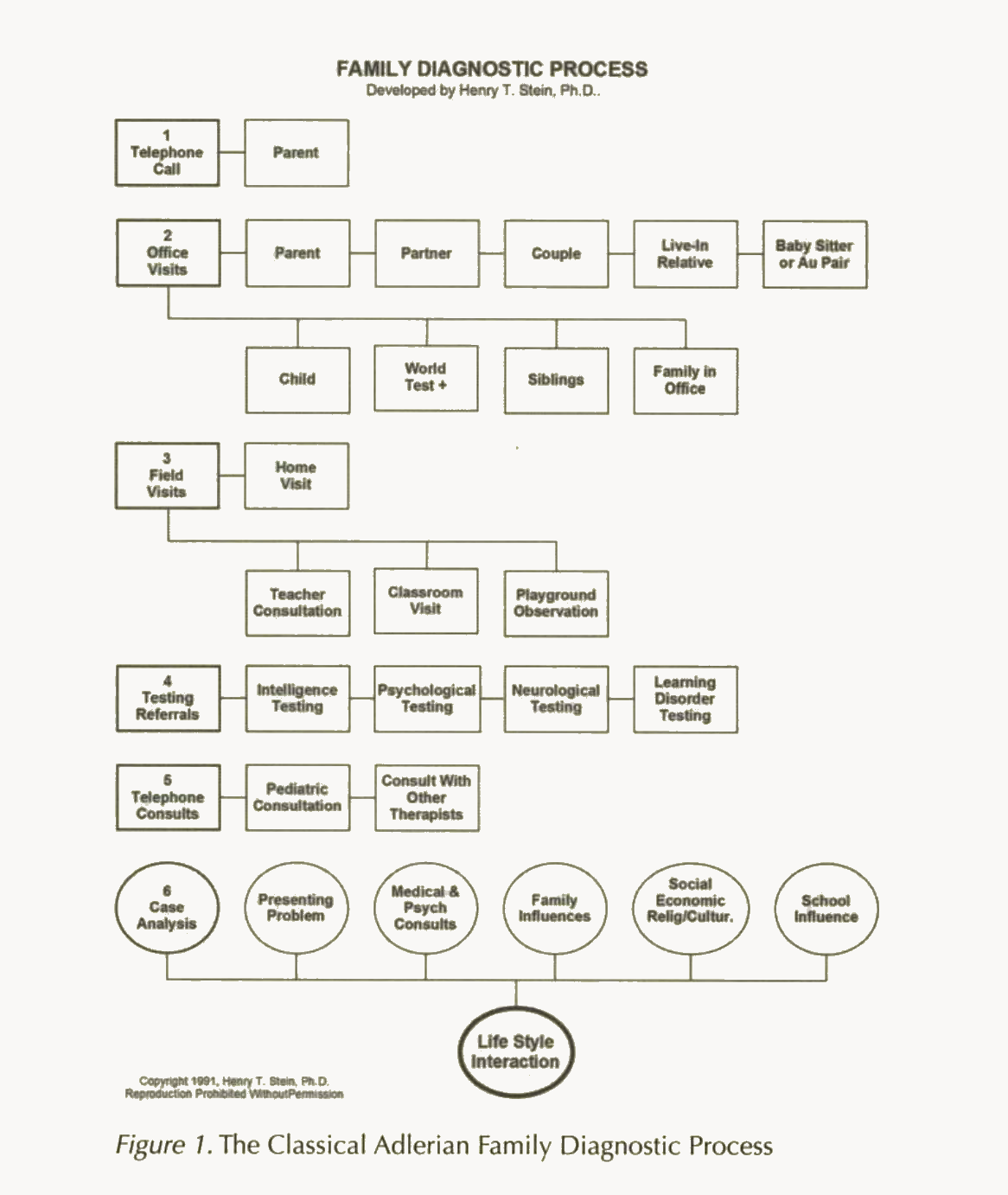
The essence of what we are trying to do in each of these diagnostic components is to discern and uncover the underlying psychological movement of the given family member. While psychological movement is a major construct in Individual Psychology, not much has been written about how clinicians look at and understand it (see Stein, 2013, but especially Stein, 2014, which addresses psychological movement at length). In Classical Adlerian Depth Psychotherapy we see what our clients are doing, we hear what they claim they are doing, and we have a sense of the impact or result of what they are doing. Through this observational process we are trying to imagine the purpose of the behavior (the fictional final goal), and we start to look for what clients are not doing by this behavior. As we start to understand what clients are avoiding, we see what they do not feel prepared to face. Then we can better understand their feeling of inadequacy (the inferiority feeling). Knowing what is missing and what it would take to heal the situation is key to our therapeutic work.
Our clients have practically no awareness, consciously or unconsciously, of what they are leaving out. How can we explain behaviors that lead to such negative outcomes--so many mistakes--from quite intelligent people? Why do they do this? And our clients pay such a high price: the suffering; the anxiety; the negative reactions from children, spouses, and others. Why would anyone pay such a high price? Most often it is because the gains they perceive outweigh the price they are paying. It is the price they are willing to pay to achieve their fictional final goal. Only when the price gets too high do clients present and ask for help. When they initially come to therapy, it may not be to solve the problem as much as to alleviate symptoms. Early in the diagnostic process we cannot talk about these concepts with clients. Still, we are looking for clues of the fictional final goal and the underlying inferiority feeling: questioning and guessing at plausible answers.
To be given only a summary of the problem, without allowing us to hear information from all concerned in the family dynamic, will limit our ability to understand the case. We need to be able to see the psychological movement in context. In the diagnostic phase we put together a very detailed picture of what is happening. Components such as home visits or asking about a typical day help us understand the ongoing situation even though we cannot be present in those everyday activities. We do not get to see everything, of course, but the family diagnostic process enables us to piece together a picture that can eventually reveal what clients are avoiding. There is no guarantee, but if clients in a given family can eventually start to add what is missing, there might be a chance that they could win one another over to listening, thinking together, and working through the difficulties with a respectful, caring, and kind attitude. Almost any relationship in a family could be improved or healed if any of the members tried something different in a positive direction.
To help in imagining the psychological movement, we use all of Adler's constructs as demarcated by Stein (2013). We take the wealth of information we collect and search for common denominators. The richness and utility of these constructs cannot be done justice in this article, but we give you a taste of them to whet your appetite. They include the following: striving for superiority (defined in five areas: physical, intellectual, psychological, social, and economic); the degree and zone of activity (cognitive, affective, behavioral: follows the direction of the striving); community feeling (the level at which the client shows his or her embeddedness in community, and the range and depth of connection with, toward, for, among others); movement (the intention of the client linked to the direction of striving and impact on others); task avoidance (what is missing or being minimized: what is not being said or done, or what has been left out); symptoms (the reason given for not moving in the right direction that protects the client's feeling of self-worth); antithetical schema (the client's unexplored, unconscious, dichotomized understanding of the world formed in childhood); the range and depth of feelings (the emotional energy given to an experience, thought, or act that motivates the client to move in the direction of the life style); inferiority feelings (the feeling of being inadequate or incomplete that motivates toward compensation and mastery); compensation (the natural movement to overcome the feelings of inferiority); counter-fiction (externalized behaviors, attitudes, beliefs, or feelings that are socially acceptable and used to cover up the fictional final goal); depreciation tendency (the movement of diminishing the value of another); style of life (the unifying patterned movement of the individual that strives toward a fictive goal); private logic (a personal understanding of how life operates and how the individual must operate within it to be successful, to protect self-worth); pattern (the repeated behaviors, attitudes, beliefs, or themes that form a consistent schema that becomes evident on analysis of all the information); and the fictional final goal (the ultimate moment in the future where clients believe they will find absolute satisfaction or total safety from and relief of the inferiority feeling) (see Stein, 2013).
We cannot demonstrate all these constructs in the following case presentations. But we intend to offer enough for readers to be engaged with an actual family who ultimately prevailed over their hidden goals and made strides toward healing. We offer guesses as to the psychological movement of each family member and invite readers to do so as well. In the following, by sharing previews of each FDP component, we hope readers will experience something of the compelling process of Classical Adlerian Depth Psychotherapy.
-----------------------------------------------------------------------
FAMILY DIAGNOSTIC PROCESS: FAMILY DEMOGRAPHICS
We acknowledge that the opportunity to work with a single family with this intensity is optimal, though rare, and depends on the family's interest, willingness, availability, and financial coverage. This partly influenced our decision to demonstrate with this particular family the applicability of the FDP, something we apply in some fashion to all of our family cases. The outcome is directly related to the level of involvement of the family members.
We are also aware that by sharing extensive information on a given family the possibility of compromising confidentiality arises. Thus, in all information that follows we have disguised the family using four specific masking characteristics: while primarily drawing from one main family, some composite information was drawn from similar cases; we have altered specific family features; we have limited the description of the nonfamilial characteristics; and we have obscured the use of case details by incorporating peripheral material (VandenBos, 2001).
The family we have chosen to present was from Uruguay whom we identify with popular names. The mother is Emma, 36, and the father, Mason, 38. Emma and Mason had a 12-year-old son, Jacob, and a 4.5-year-old daughter, Amelia.
-----------------------------------------------------------------------
FAMILY DIAGNOSTIC PROCESS 1: TELEPHONE CALL
Case Example: Parent (Erik). Our initial contact with a client, either by phone or by email, is a sensitive moment in which the client is usually in distress or crisis and is reaching out for help. We are attentive and empathetic while brief. We prefer to discuss the client's concerns in person. We take the name and contact number and set a time for a meeting. The tone of the contact, whether written or vocal, is an important element to keep in mind: the attitude of the client, the urgency with which help is requested, and the details and quantity of information shared.
Session content. At the outset of the discussion Emma shared details of her concerns about 12-year-old Jacob's educational challenges; however, her attention quickly turned to her daughter, Amelia. Emma was experiencing difficulties with her 4.5-year-old daughter, who had been throwing tantrums since she was 2 years old and was experiencing behavioral difficulties at preschool. Emma pointed out that Amelia had no academic problems, "only" behavioral ones. It was not clear whether she wanted me to work with Jacob or Amelia, so I asked that she come into the office to discuss the best approach to the difficulties she was describing.
Emma wanted to give a lot of information during our phone call. When I requested that we meet to discuss the concerns, she continued to give more details about her children's difficulties. It took many attempts to conclude the call after setting a time for our meeting.
Initial questions. From the tone of the telephone conversation, Emma seemed anxious about the problems she was facing. There was urgency in her voice, and she often repeated details. Her desire to give me a lot of information while not being attentive to my request left me wondering how all this might be connected to what seemed like anxiety. Or might there be another reason?
-----------------------------------------------------------------------
FAMILY DIAGNOSTIC PROCESS 2: OFFICE VISITS
Case Example: Parent Visit (Erik). This initial face-to-face contact with clients is the beginning of the therapeutic relationship. Our empathy and sensitivity to their concerns are accompanied by a keen observation of all first impressions. Clients' physical appearance, their body language, their attitude toward us, what they notice in the office, how they move, how they interact, and of course the content of their story are all sources of information that can contribute to our understanding them as unique individuals. We are already observing clients to identify our first impressions about their psychological movement. Looking for patterns, guessing, and hypothesizing--then strengthening those hypotheses through the ongoing contact with the client--are fundamental to our work.
The structure of these sessions is not intended to see "a parent" or "a spouse"; rather, we have a session with the person. In the initial session, we typically elicit the presenting problems, when they began, what else was happening at that time, and an overview of the client's current situation. Conversationally, we gather basic life-style information such as a description of the client as a child, a description of each parent and sibling, at least one early memory, and possibly a recent dream. We show interest in the person's work, friends, relationship with his or her partner, hobbies--all areas of life. As we connect with the person and his or her story with openness, acceptance and empathy we are already starting to create a thumbnail picture of who the person is, what his or her life is like, and how the person finds his or her place in the world.
At the end of the meeting, we offer the client an individual Adlerian Client Questionnaire (see Pienkowski, 2014, pp. 383-386), and when necessary, the family Adlerian Client Questionnaire, to take home and fill out. These questionnaires can save time. If it is relevant to the client's difficulties, we also convey at this time the whole-service aspect of our work, including home and school visits and the schedule of consultations we are willing to make (see Figure 1).
Session content. Emma, who works in real estate, presented as a tall, striking figure with an engaging smile and direct eye contact. She held herself upright, was well dressed in a casual way, and wore little makeup. Her handshake was noteworthy: She put her hand forward enough to prompt my reaching out but then stopped and left me to make up the distance, to reach out to her. Her hand was limp and unresponsive in the handshake.
She was eager to begin and started talking before we sat down. It was several minutes before she paused enough for me to ask clarifying questions. Emma explained that she had received my name from an educational psychologist who had completed testing of Jacob at a local English-speaking international school. Jacob had already done poorly the previous year during fifth grade in an international school in Uruguay, Emma explained, and he was continuing poor performance in sixth grade in his new international school. Consequently, the school administrators requested that Emma find an educational psychologist to evaluate him and make recommendations of assistance. This was the typical process in place at the school.
Emma said the psychologist concluded that Jacob may qualify for the diagnosis of attention-deficit disorder and may also be developmentally delayed. She said that because the family had moved to Switzerland only recently, the psychologist suggested a retest for Jacob after 6 months in the school system. In the meantime, the psychologist also recommended several supportive interventions, including that Emma seek family support via counseling.
She identified the initial problems with Jacob as having begun "a long time ago, maybe when he was in second or third grade." She also noted that he had been "an easy child," and then she turned to her concerns about Amelia. She described how Amelia dominated her older brother: Amelia reportedly followed Jacob everywhere and demanded that he play what she wanted to. Emma mentioned that Jacob would run and hide from Amelia when he could, but this seldom resolved the matter.
Emma described Amelia as "quite the actress," hyperactive, and smart. She added with some exasperation, "She takes all of our energy; she is an energy vampire!" Going on at length, she produced a long list of concerns: temper tantrums, difficulties going to sleep, waking up during the night with a fear of monsters, difficulties making friends at school, aggressive behavior at school, and difficulties adapting to classroom rules and teachers' instructions. Jacob, in contrast, was described in fewer terms and with less emotion. She described him as quiet, unmotivated, and unable to concentrate; she also questioned his intelligence.
She said her husband, Mason, who was once a championship dancer in Uruguay when he was younger, was a stockbroker. He was "too optimistic" for her and made her feel unsafe. "For example, he leaves the car doors unlocked," which, she explained, resulted in their car being stolen the year prior. As for herself, Emma said, "I don't trust people easily, and I find many things to worry about." By contrast, she described herself in childhood as "happy and without illness." She described her only sister, 3 years younger, as sickly and weak but talkative and someone Emma would play with at times.
Regarding her parents, she initially offered only that they were not good to her and that she did not get along well with them, currently or as a child. She described herself as having a good connection with her paternal grandparents: "I would go to them every weekend as a child. They taught me to read and to count before going to school, and I moved in with them when I was 17."
When asked for memories from childhood, Emma shared the following:
Early Recollection 1 (age 10): I remember being in Grandma's kitchen and she was making pancakes. I didn't like them, so she put cheese on them saying, "This will make it better; you'll like it." I ate and it was fine and she didn't care if I got dirty.
Early Recollection 2 (age 8): My parents told us that they were going to divorce. My mom said she would stay with me while my sister would stay with my dad. I remember the day when we were trying to separate the toys with my sister; in particular I remember a dollhouse. In my mind I can see only my dad. He was very sad and he seemed guilty because I wasn't going with him.
At the conclusion of the session, Emma was clear that she wanted to continue and asked to have two sessions per week, if possible. I explained to her the family diagnostic process, asking for permission to talk with some of the people Emma had referred to: the evaluating psychologist, the school psychologist, the family pediatrician, and the teacher. A meeting with Jane for both children was fixed, and we scheduled the home visit. Emma also agreed to fill out the individual Adlerian Client Questionnaire.
Initial questions. My first impression of Emma was that she was articulate and pleasant on one level, yet verbose and insistent on the other. Her handshake was interesting and left me with a sense of having to come toward her rather than continuing a reciprocal movement toward each other. What might this mean about her psychological movement?
Her presentation of Jacob's problems was clear, and she seemed diligent in following the psychologist's recommendations, but I had the impression she was most eager to talk about Amelia, and that Jacob had become a secondary concern. Why was Emma more concerned about Amelia's behavior when it was Jacob's academic challenges that brought her into therapy? Why has she not sought help for Amelia earlier, and what of Jacob? What is the relationship between the siblings? Why has Amelia become so dominant over a brother who is 8 years her elder? Where has she learned this behavior? Why didn't Jacob stand up for himself rather than run from his little sister?
Questions about gender guiding lines were already percolating, and I was left wondering about the level of affection in the mother-daughter relationship, as well as in the father-daughter relationship. Women played prominently in both Emma's early recollections--an attentive, indulgent grandmother in the first and a mother who preferred Emma in the second. Emma's father didn't fare well at all. What might this mean for the marital couple? I was eager to meet the rest of the family and learn about their interactions.
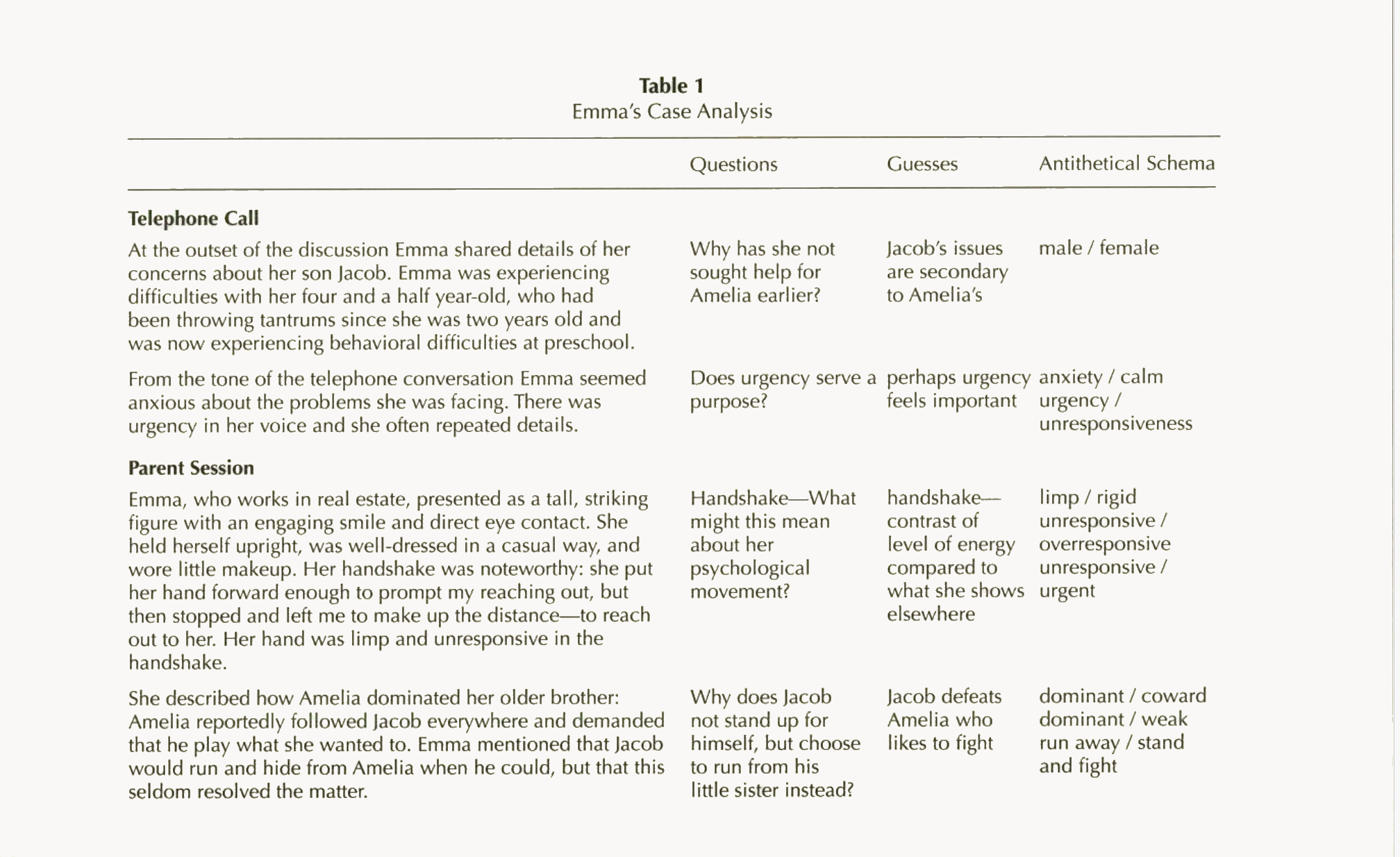
To demonstrate the organization of the material, I have given an example of some early work on Emma's information in Table 1. The example shows, using an Ecco spreadsheet (http://eccopro.com), the first questions and guesses that came to mind as I was working on the material. While our initial work takes account of all the constructs, here I have included only one: the antithetical schema. This particular construct can point to areas in which clients are polarized in their belief about themselves, others, and the world--and thereby miss or ignore the broad area of functioning in between the poles.
Case Example: Partner Visit (Erik). Meeting with both parents, if available, is essential for an optimal family diagnostic process. If one of the parents has died, for example, the information about the deceased parent is often an unseen influence in the children's lives and therefore important to gather. Similarly, in families of divorce and remarriage, the relationships with all involved adults will influence the children's behavior; this can be very challenging. Whatever the circumstances, we like to see all parental figures who are involved in the children's lives.
We meet the second parent with the same interest as we have met the initial parent. Our questions for gathering information remain identical: our interest is to understand the family difficulties from this person's unique perspective. Besides the work habits and friendships, the parental interactions regarding the children are also important. We look for such things as signs of cooperative or competitive relationships; we listen for depreciation tendencies or a sense of equality, and concern for others or self-focused behavior. These dynamics can affect the children's psychological movement and their feelings of connectedness and competence in the world.
Session content. Mason, an independent stockbroker, did not meet with me until Emma had been to three sessions. When we met he presented as a tall, well-groomed man. His clothes were casual and neat, and accentuated his athletic build. We shook hands with like firmness, yet I experienced stiffness in his arm, which kept me at a distance. Mason seemed somewhat ill at ease and broke eye contact frequently. He was serious throughout the initial interview, sitting upright as we spoke without allowing his back to touch the chair. He seemed tense throughout the session.
Mason's presenting concerns were far different from those of Emma's child-focused worries. He was more troubled about the couple and their inability to get along. He believed their problems started while they were dating, although it had become most pronounced upon Amelia's birth: "When we get into discussions they always turn into arguments because Emma insists on getting answers she likes. I say a conversation should be sharing of opinions to find a point of agreement. But our conversations never end if I don't totally agree with her. Now I'm afraid of entering into discussions altogether."
He shared more information than Emma about their arguments. Where she had said only that their arguments were related to child discipline and household duties, Mason spoke about the couple's frequent negative interactions. He said they engage in long hours of discussions, during which he feels Emma changes her attitude and position many times. At some point, he said, he starts feeling as if she is against everything he says: "I end up treating her like an enemy; I just want to get away from her." Mason explained that he sometimes breaks off what he feels is a never-ending argument and leaves the room. Emma then pursues him around the house, sometimes demanding an apology and at other times insisting on being given a hug. "I cannot do either right away. I need to sleep on it and I usually feel better in the morning," he explained.
In describing the children, Mason identified many of the same behaviors that we had heard during Emma's visit. His feeling-tone, however, was quite different. He admitted "adoring" Amelia and feeling ambivalent toward Jacob. He said his son was neither as athletic as Mason was as a child nor as intellectually curious as Amelia. Mason expressed openly his preference for the younger of the two, only wishing she would stop her anger outbursts. He felt Amelia's tantrums were largely due to the often-harsh way her mother interacted with her, something he felt he needed to compensate for by showing Amelia more affection.
Mason said his father, now retired, had also been a very well-respected professional dancer in Uruguay. He said he admired his father but noted that he, Mason, was often oppositional toward his father's demands while growing up. When he spoke of his mother, Mason used glowing terms and was most impressed that she had "sacrificed everything" for her children. He is the older brother of a sibling pair; his sister was almost 6 years younger than he. In describing himself, he said, "I was one of the best students and was always polite. I was also very good in sports. I tried to be a leader," he added, "and learned to fight for my ideals." He described his sister as modest and shy but competitive. "She wouldn't give up her opinion even if I pressured her to," he said with seeming admiration toward her.
When asked about his childhood, Mason shared the story of becoming a championship dancer. This involved his negotiating two worlds, as he saw them: the world of a schoolboy, which he was accustomed to, and the world of dance competition, which was quite mean and cutthroat. He emphasized that he eventually excelled in both but felt at home in neither. "For me, I wasn't afraid of anything and that helped. I'm still not afraid," he added, "except about losing Amelia."
Upon request, Mason shared the following early recollections:
Early Recollection 1 (age 7-8): I remember me with my grandmother in the village. I'm on my bike and it's sunny. We're in the street between houses with green yards around the street. There is poo [feces] of animals on the street and ducks walking on the street. The bike is black. I enjoyed riding the bike. No worries.
Early Recollection 2 (age 3-4): I remember how my father slapped my mother once. I saw a little blood on her here [pointing to the corner of his mouth]. I stood between both of them and started protecting my mother. I felt angry but proud that I could stand against my father at that moment and protect my mother.
Before leaving, Mason agreed to take the individual Adlerian Client Questionnaire with him and to fill it out.
Initial questions. Mason's first session provided a great deal of new information and gave a different impression of already-existing material. For example, his sharing about the couple's arguments was far more explicit; I had a sense that as parents they were quite antagonistic toward each other. This brought to mind the contrast between their handshakes: Emma's handshake had prompted me to go toward her and Mason's had kept me at a safe distance. I wondered what their individual greetings might indicate about them and their interaction with one another.
They voiced very different priorities about their difficulties. This raised questions about what was important to them as a couple, and where each as a parent was focusing personal energy. Were the children the priority or was their relationship? As both of them mentioned ongoing arguments, what might the purpose of such interactions be? What specifically about the communication pattern does not allow them to come to agreement? Is it possible that agreement is not their goal?
Questions about Mason's gender guiding lines rose as well. I wondered, for example, how his ambivalent relationship with his father might influence his relationship with Jacob. Mason's interest in opposition appeared twice in our discussion. Not only did he employ it against his father's wishes, but Mason also seemed to admire the opposition his sister had showed as a child. What part might opposition play in the couple and in their parenting styles? As to his mother's self-sacrifice, what might Mason's expectations for Emma be in this regard?
The issue of fear arises within a context: Mason said he feared nothing as a child, yet he tells of a dramatic encounter with his father who had assaulted his mother. He does not mention running away as a little boy, but he does so in his arguments with his wife. And he also mentions fighting for his ideals. Might these be antithetical schemas between fearing nothing and being fearful--between fighting and running away?
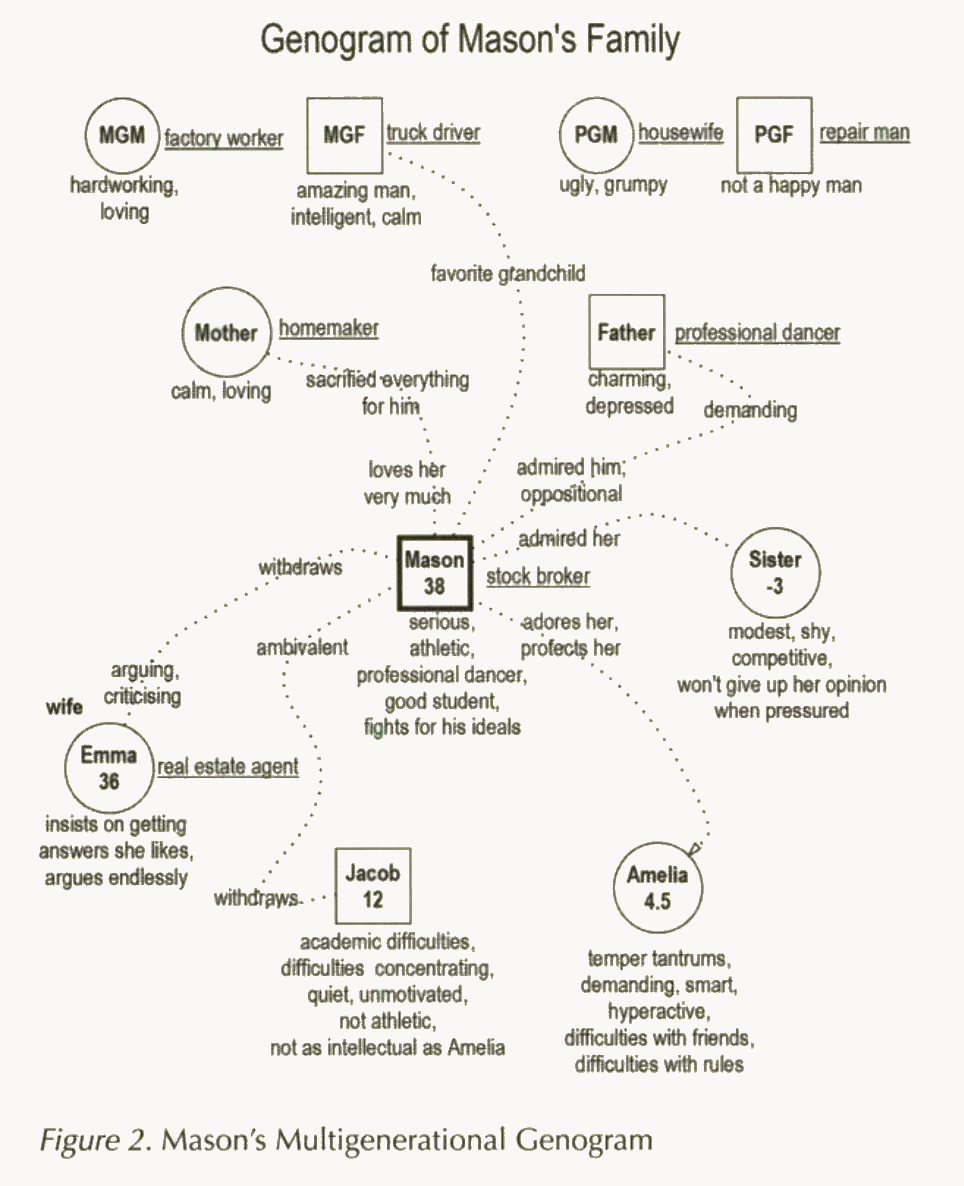
To understand a client's family structure, we use genograms. We use the EDGE Diagrammer program to adapt the genogram to our needs using our own set of guidelines. The descriptions of people and relationships are taken verbatim from the client. Neither interpretation nor guesses are involved in the genogram. It is a client's world of relationships made visual, and it is used as a key reference in analysis and in session. The generations are represented horizontally, with maternal and paternal grandparents at the top of the page, then parents of the client on the next level down, then the client and siblings below the parents. Other important people in the life of the client such as spouses are put below the sibling's area. Then the children are placed along the bottom level. The lines between the people represent relationships of significance. Text is placed on the lines to describe each relationship. Text closest to a given person represents that person's attitude toward Mason. The text closest to Mason describes his attitude toward the person on that line.
Case Example: Parenting Couple (Jane). As we have tried to show, our preference for dealing with clients is to do so one at a time. We do not usually do family sessions for diagnostic purposes as other theoretical approaches do; rather, we typically do them much later in therapy. While gaining impressions and gathering information from the couple is very important, the more important issue is making the connection with the individual. Working with two people at the beginning makes it much more difficult to establish contact with either. What can happen is the therapist can get caught up in the couple's struggle and their hurting one another. Watching a couple fight is not the best way to build our relationship with them--a relationship that is so critical at the beginning if we are to influence them in a new direction. As they talk individually with us about themselves and their children, what they receive from us is an interested, sympathetic reaction to their story.
The possibility of going deeper, sooner, is our interest. They may share things individually that they would never say in a session as a couple, including their unvarnished complaints about the other person.
In light of our preference to interview individual clients, we can nonetheless acquiesce to the wishes of the parents when the diagnostic process is under way. In the current case, the couple wanted help with their parenting and asked specifically to come in together to discuss this.
My work with each parent involves helping them question their own parenting style and the efficacy of their disciplinary actions and reactions. We work together to develop a common guiding ideal of democratic parenting, believing that equal dignity is at the base of all improved parent-child relationships. A democratic base can provide new experiences of acceptance, respect, and a feeling of equality--that is, an empowering love. This, in turn, can stimulate children to experiment and try out new behavior. Such experimentation opens possibilities for children to develop a sense of significance through growing competencies and contribution. If parents have not experienced democratic parenting in their own childhood, they will benefit from their own in-depth therapy to identify and change their mistaken understanding of the parent-child relationship (see Stein, 2013).
During our parenting sessions we discuss the present family-interaction patterns. For example, I ask for a detailed description of a normal day's routine. This will inform me as to how much the children are actively involved in age-appropriate responsibilities and how much the parents are involved in the children's day.
A key concept to the process of democratic parenting includes winning children over to cooperative effort for the benefit of all the family, developing the children's sense of significance and uniqueness, and showing appropriate warmth and affection. It often takes time for parents to grasp the reality that they must change in order to offer opportunities for children to change. As parents awaken to these challenges and take on the responsibility for change, they in turn can encourage, stimulate, and inspire their discouraged children. Thus, my work with parents involves stimulating openness to new concepts, developing interest in learning by trial and error, sparking curiosity in how their children see the world, and inspiring enjoyment of the difficulties.
Session content. I accommodated their initial desire to meet together, and a typical scenario unfolded: interactions between Emma and Mason deteriorated quite quickly. Each would tell me what the other person was doing wrong with the children and how the children were suffering at the hands of the other parent. While Mason talked at some length about Emma's "yelling and screaming" at the children and her "constant nagging and demanding of them," Emma sat upright, with little expression on her face but a clenched jaw and steel in her eyes.
At some point she interrupted Mason and told me that while she admitted that this was true, he was not telling the truth about his own behavior and how he often yelled at Jacob and made Jacob very upset. She believed Jacob's discouragement with school was due to Mason's impatience and negativity toward him. She believed Amelia's difficult behavior was due to Mason's spoiling her and giving in to her demands. While Emma was talking, Mason sat back in his chair and looked away, out the window, as if he were not interested in what she was saying. At times he would interject a vehement denial of what she was saying. The tension in the room was palpable.
They were willing to answer some questions about family routine when I brought their attention to the importance of working together. They said they were eager to understand what they could be doing differently and seemed willing to cooperate. However, while Emma described her version of a normal day, Mason interrupted frequently; she in turn interrupted Mason. It was valuable, nonetheless, to learn something of the family routine from waking up to the last person in bed at night. Emma started as follows:
"Mason is the first to rise. I normally stay in bed until breakfast time, which is about an hour after Mason has awakened the children. He wakes the children early, as we often have difficulties getting Amelia ready for school and consequently they often run late. Mason awakens Jacob first with a gentle tap on his shoulder. Jacob normally has no problems getting up and often plays or reads until someone comes to see if he is ready. Mason then goes to awaken Amelia. He takes his time to awaken her gently with kisses and soft words. He waits until she is ready to get out of bed and then assists her in her dressing. This often ends in disaster with Amelia screaming. I come and take over and send Mason to check if Jacob is getting ready."
Mason rolled his eyes, saying, "I don't need Emma to come and take over," and that she was always meddling in his parenting, to which Emma sharply responded that he was only wasting time with Amelia and was not effective in getting Amelia dressed. When encouraged to return to the daily routine, Emma continued:
"I then prepare breakfast, while Mason showers and dresses. Breakfast is always a battle. Amelia does not like fresh fruit, and I always insist that she eat some on her cereal, as it is good for her. This often ends in a tantrum by Amelia and I get very angry."
At this point, Mason rolled his eyes and said how ridiculous Emma was to force Amelia to eat fruit and that Emma's anger over this was unreasonable. Emma responded coolly that he did not help the situation by leaving Emma on her own to prepare breakfast. Mason looked at her with a scowl and turned to me asking if he could continue the description. I asked if Emma agreed and she reluctantly nodded her head. Mason continued:
"I then take Amelia upstairs to calm her down and prepare her for leaving the house. I drop the children at school and go to my office in the city while Emma stays at home."
Emma interjected that she did not just "stay" at home, but she "worked" from home. Mason ignored her and continued:
"Emma picks up the children from school at the end of the school day, takes them to extracurricular activities, and then takes them home. I join them around 4:30 for afternoon tea. We both help the children with homework before playtime. Around 6 o'clock the children are allowed to watch some television, play on the computer, read, or play with toys. I often do some extra academic work with Jacob while Emma often plays with Amelia. After this free time, I shower Amelia and put her in pajamas. Jacob looks after himself while Emma prepares dinner. Dinnertime is often tense, especially between Emma and Amelia."
Emma interrupted to say that Mason was also involved in conflict at the dinner table and that often Jacob was the brunt of Mason's anger. Mason responded that Emma made things worse by interfering when he was correcting Jacob's table manners. Again I invited them to complete the description. Emma concluded:
"By the end of the meal everyone is annoyed with everyone. Jacob disappears to his room until bedtime and Mason takes Amelia to prepare her for bed. He reads her stories until I have finished in the kitchen and said goodnight to Jacob. I then read Amelia a story while Mason says goodnight to Jacob. Amelia is almost always fussy about going to sleep; it is a real problem. I get really angry with her. I often leave the room. Amelia follows me--crying and screaming--wherever I go. Often Mason intervenes in the conflict and tries to put her to bed. Amelia then begs him not to leave her. This can last more than an hour before Amelia settles. We are fed up with Amelia and annoyed at each other. Mason usually goes to his computer and I try and calm myself by watching television before going to bed. Mason is the last up and often I am already asleep when he comes to bed."
The session ended with both parents agreeing to fill out the family Adlerian Client Questionnaire, and we scheduled a follow-up meeting.
Initial questions. Coming out of this session, I felt as though the couple had wanted me to see how much the other one was at fault. In accusing the other parent of doing wrong, did they feel their own behavior was adequate? Or was it a way of being seen as the "better" parent? Is this a competition between them? Were the children being used as an opportunity to criticize and depreciate the other? They seemed to have little common understanding of what the children needed. How was this related to the parenting they had received?
A striking point in the description of the normal day was just how much the parents were still doing for Amelia: waking her, showering her, dressing her, preparing her to get out the door. Did this also give the parents a feeling of being "good" parents? How much was this contributing to Jacob's discouragement? The other notable point, though no longer a surprise given information already gathered, was that Amelia was having tantrums several times a day. How much was Amelia increasing her sense of importance by taking advantage of her parents' mistaken understanding of what "good" parents do? Were her demands defeating them?
Case Example: Live-in Relative and Baby Sitter (or Au Pair). A number of interviews and individual sessions could enhance the planning of clinical interventions. The visits provide information and expand the family context and our understanding of services needed for optimal functioning. In the case of Emma and Mason, interviewing their live-in relatives and baby sitters would have contributed further information, but we were not convinced it would have given us any new information.
The au pair situation represented a different opportunity. That is, there was a whole series of child-care specialists that were hired and fired at Emma's insistence. While discussing directly with the au pairs may have provided valuable information, knowing that child-care help could not be retained was important in itself. Working with Emma in the course of therapy while she did the hiring and firing arguably netted more information than the au pairs themselves might have offered.
-----------------------------------------------------------------------
Case Example: Child Visit and World Test (Jane). Classical Adlerians are sensitive to all the clients' reactions, expressions, attitudes, and physical movements. In regard to our interactions with children, this is just as true. We note our first impressions about their level of adaptability in a new environment: their interest in detail in the surroundings, where they sit, how they present themselves, their level of activity (e.g., facial expressions, physical movement, emotional and mental expressions). Young children, however, are often unable to verbalize their experiences, perceptions, or feelings. Therefore, with our children clients, we use the World Test as a way to get into their world and their private logic.
The World Test is a projective technique developed by Charlotte Buhler (1951) and is not technically an Adlerian instrument. Still, as it emulates Adler's spirit of respect and individualized interaction, it can be used and interpreted via an Adlerian perspective. Buhler used the test in the study of children's cognitive and developmental processes. With the use of a limited number of miniature figures, called elements, the test is conducted on a tabletop or on the floor, and it is scored using a standardized rating scale designed to discern clinical (pathological) from normal (nonpathological) worlds. The basic World Test is made up of 160 elements grouped into nine categories: people, domestic animals, wild animals, buildings, vehicles, enclosures, constructions, nature, and war implements. While we have not been able to find an original set of World Test elements, we have been able to put together our own. The instructions for the World Test are simple and nondirective. The child is shown the elements and invited to build something with them.
Session content. Amelia, 4.5-years-old, was the younger of two children, with an older brother who was 12 years old. Her presenting issues, as determined from our initial meeting with the mother, included temper tantrums, as well as difficulties sleeping, with friendships, and at school. Amelia came to the office with her mother and at first was reluctant to leave her side. She accepted that her mother left us, but after her mother had gone to the waiting area, Amelia left the office several times to see if her mother was still waiting outside for her. I administered the World Test in this first meeting with Amelia.
I had set up the boxes of elements from the World Test, and once she had reassured herself that her mother was close by, she was at ease, exploring the boxes' contents. In a simple and nondirective manner I invited Amelia to "build whatever you want" with the toys on the green 30-inch-by-30-inch mat on the floor, using the objects from the boxes. She was free to use whatever elements she wanted and she was given up to 20 minutes to build her world. I do not intervene while the child is making the world but take notes about the order of placing the elements and any changes that are made. Amelia wanted to play with the figures. The World Test is used not for play but as a diagnostic tool, so what the child actually does is important. Amelia was unwilling to restrict her play to setting up a world. She wanted to make a story with her characters, making them move through different situations. I limited the time so she felt less frustration in not being permitted to play.
Amelia used only 24 of the possible 160 elements and took them from only three categories: nature, people and domestic animals. She used only one corner of the mat to place her elements and lined them up in two rows.
Amelia talked with some energy as she was setting up her world. Her narration helped me understand that she set up a row of five horses, three were "daddy horses" with three little pigs underneath the daddy horses. She talked of how the "babies" (pigs) needed to stay close to their daddies. She took one horse that she said was a "mommy horse" and put a dog and a female postal worker opposite it. This mommy horse was talking with the postal worker and waiting for the packages to arrive for the dog's birthday. She then took the five cows, placing the "baby cows" in a row with their mommies and daddies. She then took the three chickens and placed them at the end of the row. The five children were placed among the horses and she placed a tree behind the children and horses. Finally, Amelia put the backpack, which had fallen off one of the child elements, on top of the tree.
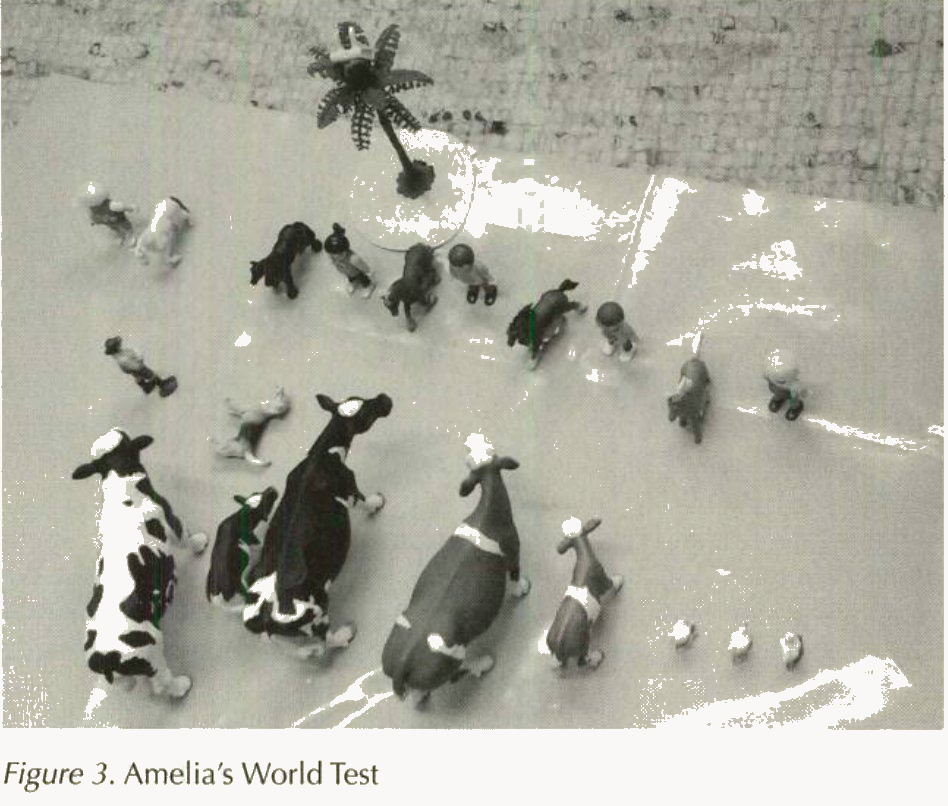
When she seemed to be finished, I asked her, "Does your world have a name?" The world did not have a name, she said. When I asked, "What is happening?" She told me that the pigs were safe under the horses and they must stay there. "Who are the children?" I asked next. Amelia was not willing to give much information in general, and even less about the children. "And what are they doing?" The children were just "with their horses."
Initial questions. Since a full explanation of World Test analysis is beyond the scope of the current article, I will limit my comments to what seemed to be most pertinent to the family dynamic at the time of testing.
Besides her narration while she built her world, Amelia was unwilling to share much more information. She seemed quite annoyed with me that she could not play with the elements and seemed to dislike my questions, ignoring some of them and replying, at times, with a quite loud, angry tone.
I was less concerned to score the World Test; rather, it allowed me to make some guesses from her configuration of the elements and her attitude and physical movement during the process.
Amelia's fine and gross motor skills seemed age appropriate as she went from the different element boxes to the building area of her world. She did not hesitate about what elements to take and did not change her mind over the course of the activity. She was a little rough with the elements and was quickly annoyed if they fell over, picking them up with a loud huff and banging them down on the mat.
At the preschool level an arrangement of only a small number of elements, using only two categories, and placing elements in rows is not considered symptomatic of emotional disturbance as it could be with older children. It is interesting to note that Amelia did not use any of the elements representative of aggression (e.g., tanks, soldiers, cannon), nor did she confine her elements with enclosures (sometimes an indication of safety or confinement issues). It seemed significant that the only adult in her world was a female postal worker, and that postal worker's function, according to Amelia, was to bring gifts for the dog.
My preliminary observations left me much to question. Might it be that the male-female gender guiding line is apparent in the roles of the male horses and the female horse and postal worker? Might it be that men are to protect while women are to bring and receive gifts? Could this be a way her mother buys back Amelia's affection after being angry with her? Does this represent a pampering attitude of other women in her life? Does Amelia expect or desire such an attitude? Antithetical schemas of strong-weak and above-below seem to be present in her placing the pigs under the male horses. I also wondered whether I was seeing Amelia's normal frustration level and whether I might see more of this in our future meetings.
I observed conduct similar to what was likely causing Amelia difficulties in the classroom: She did not like having instructions to follow, even as simple and nondirective as mine. She desired to do what she wanted rather than what she was asked; she did not want to be restricted. Why did Amelia not like my questioning her about the world? Was this because she was angry with me for restricting her play, or were the questions annoying to her for other reasons? Might she have been indicating her lack of willingness to interact or cooperate? Is this apparent only with adults, or is this the struggle she is experiencing with her peers?
-----------------------------------------------------------------------
Case Example: Sibling Visit (Jane). To have a complete picture of the family, all siblings normally are invited to come into the office for at least one session. Siblings are often aware of dynamics that the parents are overlooking. The siblings' different perspectives also bring new light to dynamics that parents have mentioned but may minimize. We are interested in knowing the dynamics that keep the siblings in tension with one another, representing a major aspect of the family interactions. These new perspectives give us richer information from which to draw our conceptualization.
Often when one sibling is the focus of attention for negative behavior, the other siblings are contributing to the dynamic in a way that maintains the status quo. This may allow the siblings to pass under the radar of their parents who are overly concerned by the problems of the focus child. By drawing attention to the negative behavior of the focus child, the siblings can feel that they have an advantage over that child. The emphasis on the "difficult" child may hide the "good" child's own feelings of inadequacy. The effort involved in reducing the negative atmosphere and increasing a more positive outcome may not interest the other siblings and may even feel threatening to them.
Session content. Jacob was not eager to come into the office, to talk with either Erik or me. He hesitantly agreed to come and talk to me when asked if he would help me understand Amelia's difficulties at home. His greeting was polite but reserved. He sat on the sofa with his eyes cast down, showing little interest in the surroundings. As I asked him questions, he quietly answered in short sentences and seemed to be ill at ease. When asked if he were uncomfortable in the office, he said that he did not really think he could help me.
When I asked him if he would be willing to do a World Test, he showed a vague interest, which I interpreted as agreement. I thought he might feel more at ease doing some activity than speaking with me; and it would certainly be helpful to understand something of his perspective. As I brought down the boxes, he showed increasing interest in the elements, ultimately working quietly for the 20 minutes without interruption and without asking any questions.
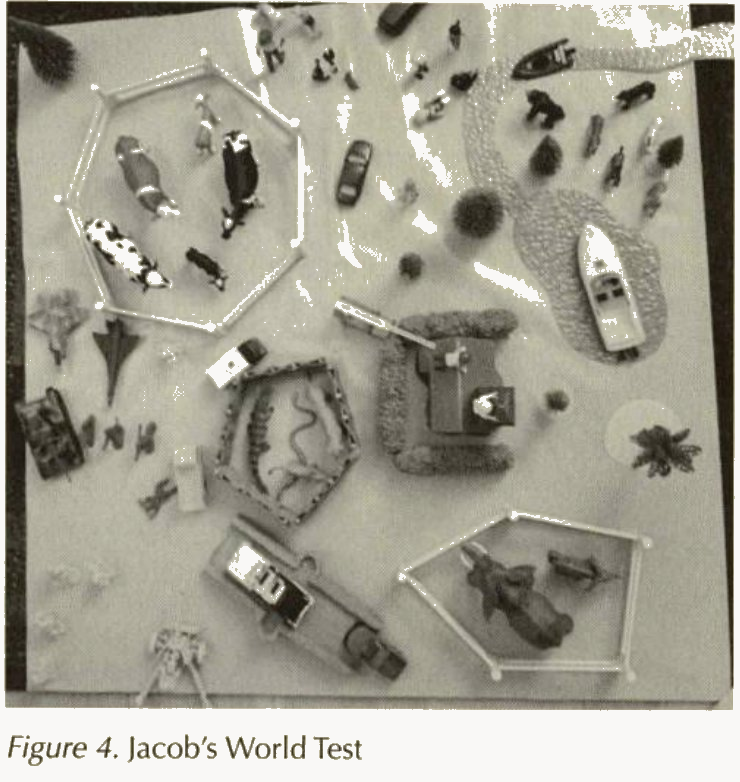
Upon scoring the World Test, Jacob's elements were found to fall within "normal" parameters. The order that he put his pieces down was as follows: He started with the church and then some trees, the river, and the lake. He then added the five horses in the area between the lake and the river, and the children on the opposite side of the river. He put the boat on the lake and then the hedge around the church. He then set up some fences and added the cows. Next he set up the walls and put the snake and crocodile inside them, adding the baby and adult lion. He then sat the baby monkey on one side of the river playing with the children and the adult monkey on the opposite side with the horses. The cat and kitten were put outside the cow's enclosure and then the baby and adult elephant were put into a fenced area. Another boat was added, and then he set up the military elements and the cars and fire truck. He then added the man with the dogs near the cats and finished with the two children on the roof of the church.
When asked, he said that his world did not have a title; however, he shared the following information: There was a war on and the cannon was going to kill the cows that the farmer had captured. The farmer wanted to save his cows from being killed. The farmer was actually trying to stop a fight between the two dogs, and the cat was mocking them. The horses had just come to get a drink from the river and would be going away. The children were laughing so much at the baby monkey that one child had fallen down with laughter. The mother monkey was worried about the baby monkey but could not reach the baby. The other wild animals were in a zoo. The children up on the church were trying to run away and became stuck on the roof. The fire truck was there to help them get down but the fireman was watching the baby monkey with the laughing children wondering whether the monkey had escaped from the zoo.
Initial questions. While Jacob had been the point of entry for the family work, Amelia had quickly become the focal point. Nonetheless, as the sibling of the focus child, Jacob's own issues were of great interest to us. His initially passive behavior in the office seemed to indicate that he was waiting for instructions. Could this be due to an overemphasis on obedience at home? I wondered if it had a negative impact on his curiosity and openness to new experiences when he did not know the rules. He did not like being the focus of attention in a formal way, so the World Test served as a playful, informal information collection in which he readily engaged.
Jacob's World Test and subsequent explanation was a rich source of details that gave us much to work with in our later conceptualization about his life style. His use of different sorts of enclosures could mean both a strong interest in being safe and a feeling of being caught or being restricted. We might ask whether he is afraid of being enclosed or might he like to enclose others for his own safety? An overriding theme of aggression seemed apparent: dogs fighting and soldiers wanting to kill the captured cows. Jacob also opens the comments about his World Test with the acknowledgment of war. Might these indicate an otherwise unexpressed sense of oppression or hostility he experiences in the family?
What war does he feel he is involved in? Whom might he like to be fighting? Might the placement of only two adults (of 16 possible "adult" elements, excluding the soldiers), both males, indicate that adults were of no help to him? In support of this, first we noted that though the fireman had given the children a ladder, he was not personally involved in helping the children off the roof. Second, the farmer had captured the cows to protect them, but then had made them vulnerable to the soldiers' attack by doing so. If accurate, this would be an interesting reinforcement of a hypothesis from Amelia's World Test. In their family is the father the figure of protection but also, for Jacob, a threat of humiliation? Jacob seems to have ambivalent feelings about the enclosure, which might represent both protection and danger. Is Jacob expressing some of his antithetical schemas in the pairing of captivity-freedom, safety-danger, being captured-escaping? Might the mockery of the cats toward the dogs (as well as the children's laughter at the baby monkey) represent depreciation or a sense of humiliation?
Jacob left out any adult women. Might this show a sense of emotional distance from his mother or other female figures in his life? Regarding his mixing of children and monkeys (and the placing of the mother monkey on one side of the river while the baby monkey played with the children and made them laugh on the other side), does this seemingly safe distance from his mother represent how he feels today or how he would like things to be?
Case Example: Family In-Office Visit. Family in-office occurs seldom, if at all, within a family diagnosis. While open to any variation of meetings to help develop our impressions, we use this type of session later in the therapeutic segment when appropriate to the work of the individual family members. As with the others, we deal with this component creatively in terms of what is relevant.
-----------------------------------------------------------------------
FAMILY DIAGNOSTIC PROCESS 3: FIELD VISITS
Case Example: Home Visit (Jane and Erik). During the home visit, our objective is to observe the family members' dynamics within their most familiar environment. We are interested in all the details of their surroundings, from the material objects to the human and animal interactions. A visual image of their home setting gives us a mental picture of the geographical layout involved when the family talks about situations at home. This allows a deeper understanding of context.
We typically try to make the home visit early in the relationship. The children usually feel more at ease in their own territory than in the office, especially in the beginning of the relationship with us. There is the possibility in a home visit for a reciprocal experience for the therapist and the children--a sort of balancing out such that the therapists willingly face an unfamiliar environment while the children are at ease. By the therapists coming in at a "one-down" level--subordinate rather than superior--the children might experience the relationship heading in the direction of equality. A home visit can also be an opportunity for connecting with the children in a very personal way, creating a memory of a shared experience that can be referred to during future therapeutic opportunities.
We normally ask the youngest child to show us around the house. Improvisation is also important during the visit so that whoever is interested in showing us the house is welcomed to do so. Having shared with the parents in advance what we will do, the parents typically leave us to do the tour alone with the child. We ask questions of the "tour guide" about the different rooms and objects, eliciting information about what is important to the child, about the child's involvement and contribution to the family. We are looking for how a child may find a feeling of significance. When in the child's room, we ask questions about the child's interests and activities. We look for anything unusual or exaggerated and question when appropriate. We ask the child to show us favorite toys, games, and books, and we question why the child likes these things. We then ask the siblings if we may visit with them in their rooms individually. After the tour we like to bring the family together and discuss the idea of family meetings.
Session content. When we arrived at the address we found high security walls and locking protective gates surrounding the house. This was common but not universal for the neighborhood Emma and Mason lived in. We rang the entrance bell and were asked to identify ourselves. After we were recognized on the security camera, the gates opened and Mason came out of the house to greet us. As we approached the front door, Emma and her mother also came to greet us. Emma's mother did not speak English, and she went back to the kitchen, where she was cleaning up from their lunch. Jacob came from his room to greet us while Amelia actively ignored us and continued to play with her dolls in the kitchen area near her grandmother.
Emma told Amelia to say hello to us, which she refused to do. Her mother raised her voice while looking at us with slight embarrassment, insisting again that Amelia greet us. Amelia again flatly refused to do so while running away to the living room. Her father followed her and took her in his arms and talked to her in a low voice. At this point we asked Jacob whether he would like to give us a tour of the house. He was slightly embarrassed and looked at his mother, who told him to show us around.
Jacob took us through the living room and dining areas while responding with minimum information to our questions. At this point Amelia came to join us and asked Jane to play with her. Improvising, we decided that Erik would continue the tour with Jacob, and Jane would talk with Amelia. Jacob took Erik upstairs to his bedroom, which was tidy. He had many nature books on the shelves and a modest amount of toys. Jacob seemed more at ease with Erik alone. He shared with Erik the difficulties he was having with Amelia, specifically her screaming. He said this occurred whenever she was asked to do something she did not want to do. He said the screaming was especially disturbing to him when she would insist that he do things for or with her. In the tour of the garden, he showed Erik the four secure hiding places that he had found to escape from Amelia's demands.
After showing Jane the dolls she was playing with, Amelia took Jane to her room. The room was decorated in pink with a large, low bed off to one side covered in soft toys. Everything was very neat and organized. A little table and chairs were in the center of the room, and she wanted Jane to sit with her and listen to some music on a child's tape recorder. She seemed excited and energetic as she sang along with the music. Jane showed interest in games on the shelves, and she asked questions about Amelia's favorite things to play with and how to play a certain game. Amelia ignored Jane's questions. She pulled Jane over to the bed and showed her the soft toys, explaining how she slept with a plush stuffed bear that was almost as big as she was.
As Jane prepared to leave Amelia's room and join the others, she asked Amelia to accompany her. Amelia became quite agitated, wanting to show Jane more toys and insisting that Jane stay. Jane firmly and gently told Amelia that the time together was finished and that they would join everyone else downstairs. Amelia started to raise her voice and demand that Jane play with her. As Jane left the room, Amelia started screaming. Her mother appeared and tried to talk her into coming downstairs. Amelia continued to scream, now at her mother. Her mother insisted that Amelia stop screaming and did so by raising her voice considerably. This interchange continued for several minutes until Emma picked up Amelia and offered her a favorite cookie if she came downstairs. Amelia calmed herself, insisted on being put down and ran out in front of us down the stairs to the kitchen, where we gathered to drink tea. She did not stay at the table for very long and disrupted our conversation with loud noises and requests for help with her game, which she had spread on the floor in the kitchen area. Her grandmother tried to play with her, but she did not want her grandmother with her and demanded that her mother help her. It was Mason who went and sat down with her and started playing.
As we gathered for tea, Jacob seemed quite distressed by his sister's behavior, although he politely answered our inquiries about activities the family did together. He showed interest when we talked to him about the possible implementation of a family council--a meeting with the family members, we explained, where everybody can bring up things that are bothering them, where they are listened to with no interruptions and no punishment, and where they can solve problems together. We discussed how he could start by making a list of things that he wanted to talk about: anything he liked, didn't like, things that bothered him, or things that he was feeling. Despite his interest, he seemed to doubt this was possible, and we assured him that we were also encouraging his parents to start a family council. Although we are willing to model the council on such occasions, this was not feasible given Amelia's behavior; consequently, we soon after said good-bye.
Initial questions. To recall all that happens during a home visit, we usually stop in a convenient place as soon as possible after the visit and write down all that we can remember. In our observations we noted the high security at the entrance. Although this was somewhat common in the area where they lived, what would we find were the more personal reasons for this level of security?
The moment of greeting is a key moment in a home visit; it is the unguarded moment where the projection of personality is more visible. Mason's greeting was friendly and welcoming while Emma seemed more nervous and immediately concerned about Amelia's behavior. Might it be that Emma is more concerned about impressions than actually dealing with the reasons why Amelia is being uncooperative?
Amelia demonstrated to us her omnipresent methods of defying her mother, keeping her father involved with her, and disturbing her brother. We had witnessed this little girl's power in her family firsthand. She seemed quite skilled in her control over others. Defiance and demands, rather than in any way addressing the needs of the situation, seemed to be the order of the day. It seemed that the family atmosphere was one of competition and dominance. Was this gender influenced? Had Amelia learned this from her mother or her father?
Jacob's behavior seemed to be compliant with his mother's expectations. Is compliance all she wants from her children? Jacob did what he was told to do, but he seemed reserved and slightly ill at ease. What might be the purpose of his compliance? Does his compliance allow him to stay under the radar? Does it cover up for a lack of confidence in dealing with new experiences or other people?
We were struck by Jacob showing Erik his hiding places, when we remembered enclosures were prominent in his World Test. Is his running away and hiding from his sister, mirroring his father's withdrawal from his mother? Interestingly, when alone with Erik, Jacob was more open and articulate than we had been led to expect by his parents. Was he more at ease with men than with women?
-----------------------------------------------------------------------
Case Example: Teacher Consultation (Jane). The teacher consultation is an important source of information when working with children. Classroom experiences place children before new and challenging tasks. If children have been socially well prepared they will typically face the tasks with courage and cooperation. When children do not feel prepared (i.e., have not been given the guidance and opportunities to develop their sense of significance and belonging in a healthy way) their own mistaken style of protecting their self-esteem will be evident. We understand this interactive style to be the prototype for the child's developing life style.
Consultation content. During the time of the consultation, Amelia started her second year of preschool (in Switzerland's international school system, this is equivalent to kindergarten in the United States). This involved more structure, rules, learning, and social expectations than in her first year, which had been focused on play and social interactions. Having seen the parental couple and heard of the difficulties that Amelia was having in preschool, I asked to meet her teacher. The parents agreed and helped arrange a meeting.
Amelia's teacher welcomed me into the classroom. It was a large space with many windows that allowed natural light to enter the room. We sat at the little tables that were grouped to make larger blocks of four that accommodated eight children at each square. The walls were decorated with children's paintings, alphabet letters, and pictures of different places in the world. Shelves around the room were full of books and folders. It was a vibrant and colorful environment.
The teacher explained to me that Amelia's behavior and attitude were challenging her patience, skills, and--in fact--her sense of competency. She was a young teacher who had been teaching for about 6 years. She said she had never felt as defeated as she did when confronted by Amelia's behavior. She had not given up but acknowledged that she felt stressed and worn out.
The teacher talked of Amelia's demands for constant help when put to work on a learning task, her strong reticence to try new things, and her desire to be the best or first in activities. She recognized that Amelia was a bright child who learned quickly when motivated. She talked of how Amelia would unexpectedly refuse to do something that she had done without any fuss the hour or day before. Amelia seemed unable to stay focused on a task for very long before disturbing the other children or the teacher. She then explained how Amelia did this by shouting and calling out questions and remarks. She would also get up and walk around rather than apply herself to a task. The teacher was also concerned about Amelia's social interactions with her classmates. Amelia was bossy, demanding that others do things her way; she could become quite aggressive verbally, and at times physically, by pushing or shoving.
The teacher had tried many things to discipline Amelia: talking with her about what was appropriate and expected of her, sitting her at a desk on her own, using a chart with stars that were given for good behavior and taken away for inappropriate behavior, and sending her to the school psychologist or the school director as punishment. Nothing seemed to have changed Amelia's behavior for very long. The teacher was amazed at the persistence of Amelia's negative behavior and was concerned that Amelia's learning was going to be affected.
She had talked with the parents many times and felt that Amelia's mother was critical of the teacher's attempts to discipline Amelia. Emma excused Amelia's behavior by suggesting that others in the classroom were affecting Amelia and that the teacher was too strict.
Initial questions. The teacher provided important information. Although her descriptions of Amelia's behavior were not much different in content from other sources, hearing that these problems manifested within her peer group gave us deeper concern for the extent of Amelia's discouragement. To what degree was this bright little girl willing to sacrifice her education to ensure that she was the center of attention and in control of every situation by which she found herself confronted? What an exhausting course of activities she had set for herself, allowing practically no one but herself to influence the classroom. Of related concern was the apparent disruption in the teacher-student relationship. Emma's protectionist attitude could have been influencing Amelia's attitude toward her teacher, thus creating Amelia's resistance to corrective guidance and the development of problem-solving skills in the face of her ongoing frustrations. Is the teacher's discouragement and sense of failure an indication of Amelia's ability to defeat any adult, whether the adult wants to help or harm her? For what does Amelia's desire to defeat an adult compensate?
-----------------------------------------------------------------------
Case Example: Classroom Observation (Jane). The classroom observation is a key way of being introduced into the child's social and academic worlds. Because the child is aware that an observer is in the classroom, there is a tendency to exhibit less extreme behavior. Still, the child cannot restrict her normal dynamic for very long and soon forgets that the observer is there. Opportunities also arise to observe interactions with peers and how the child responds to structure and learning expectations. The classroom observation is organized with the teacher in order to sit in on lessons that are normally a challenge for the focus child. The teacher tells the child that an observer will visit the classroom and when the visit is to occur. I work with the child in a pre-observation session to help prepare for the visit.
Observation content. On arriving at the door of the classroom, Amelia ran to greet me and gave me a big hug; this was unusual because she normally did not greet me when coming to the office. The teacher asked me in and asked Amelia if she wanted to introduce me, which she did. She explained that I was someone she went to see to talk about things that worried her. She seemed quite at ease, and the teacher reported later that she had been asking all morning when I would be coming. I sat at the back of the classroom and Amelia went back to her seat, watching me from time to time.
The children were sitting in groups of six. The teacher had permitted my observation period at a time of the day when the groups were given a sequence of tasks to accomplish. They had 10 minutes on each task and then were expected to move on to the next task. While one group was working individually on spelling or math games on iPads, another group was working with an assistant teacher on a game of questioning to find clues or cryptic answers. Another group was practicing writing by copying a word that was written on a word card. The word card was put on the table and the children were expected to take turns in viewing the word. The last group was doing some reading with the teacher in the back corner of the classroom.
As in every classroom, some children listened and understood the instructions, eager to start the work, while others dawdled, questioned what to do, or were distracted. While the majority were on task, Amelia was talking very loudly to one of her classmates and had not heard all the instructions. The teacher repeated to her where she was to go, and Amelia seemed to be happy about the activity that she was to do. She then followed the instructions.
Amelia's group was asked to go to the reading table with the teacher. Amelia sat down with her book and wanted to go first. She read with confidence, spelling out words aloud when she did not know them by sight. She was engaged and seemed to enjoy the activity. When the other children were reading to the teacher, Amelia came over to show me her book. I glanced to the teacher who signaled to me her approval. Amelia told me about the story she had been reading. She became frustrated when she could not find the words she wanted to describe certain points of the story. If I suggested a word, she raised her voice and told me, "It wasn't that." She soon left me and went back to the group. When the teacher asked everyone to move on to the next group, Amelia loudly told her friend next to her (who seemingly did not hear the teacher) what the teacher had said. Amelia then went and picked up her writing book. One of the boys in her group could not find his book, and she went and helped him find it. She then applied herself to her writing exercise.
The teacher instructed Amelia's group to take turns studying the word card, then to pass it on and copy it into their own books. All the children wanted to see the word card. Amelia had recognized the word and at first tried to write the word without using the word card. She then seemed to have a moment of doubt and wanted the word card. The other children had been passing the word card around, and it was not yet Amelia's turn to have it. She became loud in her demand to see the card. The teacher intervened, asking her to speak more quietly and to wait her turn. She then got up from her seat to look at the card over her classmate's shoulder. She then went back to her chair and finished writing the word before some of the others had even started. She then started writing other words that were not asked for.
Soon it was time for her group to have the individual iPads for the spelling and math games. The teacher set up each child with a game in a specific area where the child needed practice. Amelia did not like the math game the teacher had chosen for her and told the teacher she did not want to do that game. The teacher encouraged Amelia to finish that specific math game and told her that she could play other games when she had finished. Amelia continued to complain and did not start her work. The teacher reminded her that if she did not want to work, then she could sit quietly and do the computer games at the recess time. When the teacher went to the reading group that was waiting for her, Amelia got up and started to talk with other children. The teacher then asked Amelia if she would like to leave the group and go and sit in the timeout area. Amelia said that she did not want to leave the group and took the iPad again. She had not completed the game by the time the teacher called for the last change of activity.
The last activity for Amelia's group was the guessing game with the assistant teacher. The assistant teacher had four piles of cards to draw from, each pile with a different topic: geography, sports, food, or professions. The assistant would draw a card and kept it to himself. The objective was for the children to ask questions that would help them guess the specific picture on the card; this was done by taking turns and asking in a quiet voice, to not disturb the other groups. Amelia seemed eager to find the answer. She did not wait for her turn. She spoke loudly and often interrupted the other children with her questions. The assistant asked her several times to wait for her turn, to speak quietly and not to interrupt. Finally the classroom teacher came over and asked Amelia to sit in the timeout area. She refused to go but sat quietly at the desk. She no longer participated in the game. By this point it was the end of the class and the children were going out to recess. I said good-bye to the class, and Amelia hugged me again as I left.
Initial guesses. Some of Amelia's behavior in the classroom mirrored behavior I had already seen at the home visit and in the office--her resistance to doing things that were asked of her and her desire to keep people busy with her, often in negative ways.
The classroom visit netted a wealth of questions and guesses from my arrival until my departure. For example, was the hug at my arrival a way of drawing special attention to herself? In identifying me as someone she could speak to about her worries, she seemed very clear about why she was coming to the office. However, as of that time she had not shown any desire to talk about things that were worrying her. Was this indicating her desire to be seen as understanding the reason for therapy while she refused to cooperate? She clearly felt that she was special because of my visit.
Was Amelia's rather surprising compliance to work on reading due to her confidence in reading? Might her refusal to accept any of my suggestions about word choice come from a belief that accepting help is a sign of weakness? Amelia returned to the group rather than struggle through the difficulty of finding her descriptive words to tell me the story. Might she have been declaring that when she does not have the words or the answers to questions, she feels incompetent and wants to avoid this feeling? Were Amelia's interactions of repeating to her friend the instructions and helping another find his book acts of cooperation or acts of dominance?
In witnessing Amelia's lack of cooperation throughout class, until the very last activity, might we guess that being quickest or the first is more enjoyable to her than the process of learning? It seems clear that Amelia has not learned the joy of effort and the deep sense of confidence that is gained by struggling through the difficulties and overcoming them.
-----------------------------------------------------------------------
Case Example: Playground Observation (Jane). Playground observation is best done when the child is unaware of the observer. Permission is sought from the school, and the teachers on playground duty are aware of my presence without drawing attention to me. The fact that the focus child is unaware of my presence allows me to see interactions that are not influenced by the availability of a familiar adult. The interactions between children are a great source of social learning for them. Anthony Bruck (Bruck, Adler, & Grubbe, 2009) reminded us that adults should not interfere with playtime, since children work better at finding their own rules and ways of interacting by experimenting. Playground interactions are also a source of information as to a child's understanding of friendship.
Observation content. The playground observation took place on the same day as the teacher consultation and a different day from the classroom observation. The playtime recess that I was observing was only a short break in the middle of the afternoon. I was able to stand in a sheltered area at a distance from where Amelia was playing with her girlfriends.
Two girls were on the swings, and Amelia was standing next to them. From the distance, I could not hear distinctly, but she seemed to be addressing them. The girls ignored her. She started to raise her voice, and I then heard that she wanted them to get off the swing and come and play on the slide with her. One of them shook her head, and the other said nothing. Amelia requested several times with a loud voice that the girls leave the swings, and each time the girls refused even to acknowledge her.
Amelia then picked up the jacket on the ground next to the swings and went running off with it. This was obviously not her jacket because one of the girls on the swings jumped off and started running after her. Amelia was a fast runner and the other girl could not catch her. After several minutes she had tired the girl out. Amelia slowed down and let the girl grab the jacket. Soon they were in a tussle over the jacket with loud screams and forceful gestures. The teacher on playground duty intervened, separating them and giving the jacket back to the owner.
The teacher did not want to know who had done what and told the children to go back to their playing. The owner of the jacket ran back to the swings to join her other friend. Amelia did not follow her but went across to where the boys were playing football. She did not try and join them but watched for several minutes until the bell rang for the return to class.
Initial questions. Fascination with Amelia's playground prowess engendered many questions. Playground rules are partly brought from home, partly taught, and partly made up--where had these girls learned to ignore Amelia's specific request? Might they have learned it from Amelia herself as she ignores others, or had they devised it specifically to defeat Amelia?
It was fascinating to see Amelia get the girl to chase her and to pace the event so masterfully as to get the girl to engage in the coat tussle. Once she had no strong competitor, was the chase no longer fun? Was the fight over the coat more motivating than winning the chase? Might Amelia prefer to be playing with the boys? Might she have difficulty matching her interests and energy levels with a girl peer group? Regarding Amelia's apparent athletic ability and energy, might she be more involved in physical activity that would be productive and healthy for her?
-----------------------------------------------------------------------
FAMILY DIAGNOSTIC PROCESS 4: TESTING REFERRALS
Case Example: Intelligence Testing (Erik). As the point of entry for services of the family had been Jacob's poor school performance, this component of the family diagnostic process received greater emphasis from the educational psychologist. She referred Emma to us and was given permission to share her findings with us. Through this contact we learned of her concern for the family.
Consultation content. The psychologist said she had met with Emma twice. Each time Emma emphasized her concern that Jacob might not be "an intelligent child." It seemed to the psychologist that Emma had an incomplete understanding of developmental and educational delays, and her fear that Jacob might be mentally limited was disproportional to the difficulties he was experiencing. The psychologist took the concerns seriously nonetheless, and after testing and interacting with Jacob, she concluded the developmental delays were not pervasive. She suspected guidance of the family was called for, not exclusive, academically oriented attention to Jacob.
The psychologist said she confirmed her notion that family therapy was appropriate during her second visit with Emma. During this visit, Emma asked if the psychologist might also see Amelia at some point and evaluate her. The child, however, was so resistant to interacting with the psychologist that an evaluation was not immediately arranged. The psychologist shared her concern that Emma's seeming anxiety about her children's academic performance may itself be an influence in Jacob's underperformance.
In her preliminary examination of Jacob, the psychologist administered the Wechsler Intelligence Scale for Children--Fourth Edition, English version (WISC-IV; Wechsler, 2003) and the Wechsler Individual Achievement Test--Third Edition, English version with subtests (WIAT-III; Wechsler, 2009). She also worked with Emma and the school to administer the Conners' Rating Scale/Revised-S (Conners, 1997) for parents and teachers. This is the most commonly used scale in Swiss English-speaking schools for determining attention deficits. She also prescribed unstructured self-description activities with Jacob. A portion of the summary findings follows:
"Test scores and observations during the assessment reveal that Jacob is able to learn new information well, especially when this information is visual and structured in nature. Although Jacob has the potential to perform adequately at school, he is not demonstrating this in the classroom due to clear and personal limitations in working memory (i.e., attention and concentration). . . . Jacob's concentration, focus, and attention fluctuate depending on the task, and especially when he is feeling fatigued or not invested in the activity. As his brain matures, these difficulties in attention and concentration may be overcome. Nonetheless, they should be monitored over time."
The psychologist provided specific recommendations for the classroom teacher and some for the family. She did not recommend further testing at the time but suggested retesting in 6 to 9 months after the family had been involved in therapy and Jacob had experienced an adequate adjustment period.
Initial questions. The benefit of consulting with the educational psychologist included both the focused, professional assessment of Jacob's poor academic performance and a colleague's second opinion about the family interaction. Our questions and guesses went in the direction of whether Jacob's school difficulties were contributing to the family stresses or were more the result of these stresses. Given Emma's disproportionate concerns about Jacob's delays (according to the psychologist), might Emma be experiencing unfinished business from childhood around academic performance? Might we be seeing antithetical schemas of intelligent-stupid and high performance-underperformance? Is Jacob using her worry about his academic performance to keep his mother busy or even to outsmart her? Here again, Emma's concerns for Amelia intruded on addressing Jacob's needs. The psychologist's early confirmation of this hypothesis helped focus our further conceptualizing and treatment planning.
-----------------------------------------------------------------------
FAMILY DIAGNOSTIC PROCESS 5: OTHER CONSULTATIONS
Case Example: Pediatric Consultation. This portion of the family diagnostic process could include a number of ancillary contacts, depending on which relevant services the family is receiving. If the family is receiving public assistance of any sort or special medical attention, all individuals involved might be consulted. Not all require face-to-face contact; telephone contact might be sufficient if the information is limited.
In the current case, Emma demonstrated a surprising readiness to share her medical history, as well as to share her knowledge around the illnesses she had experienced. She also demonstrated great concern about her children's illnesses, so a personal contact with the pediatrician was arranged.
Consultation content. Emma helped prearrange a call to the pediatrician. He spent 15 minutes with me on the phone, during which he was forthcoming about Emma and the children. He volunteered that he found Emma attentive to the family's health but also "overly concerned." That is, she or Mason--at Emma's apparent insistence--made frequent office visits with the children. She seldom let even minor cold or flu symptoms run their course without a doctor's appointment. Still, he said, there had never been a visit that did not actually reveal an illness; none was manufactured.
He also reported that Emma had shared concerns early on about Jacob's intellectual abilities, and so the pediatrician had kept an eye on possible neurological markers during his checkups involving both children. He felt confident that there were no abnormalities in this regard and had shared that with Emma. To her credit, he said, she had not asked for excessive tests or inquiries.
Initial questions. The brief information gathered from the pediatrician added significance to Emma's childhood self-description as "happy and healthy" while her sister was "sickly and weak." Were we seeing a key antithetical schema? Learning that she had amassed a store of medical knowledge and showed an overconcern about the children's health confirmed the need to explore health as a dynamic in the family. A curious note was the doctor's reference to Mason bringing the children at Emma's insistence. Might this be her way of involving him or perhaps making demands on him? Was insisting that he attend to the ill children an indicator of Emma's attempts to defeat Mason's optimism? Was worrying about their health also compensation for what she did not know how to do--to express to her children a guiding and empowering love based on warmth and affection?
-----------------------------------------------------------------------
FAMILY DIAGNOSTIC PROCESS 6: CASE ANALYSIS AND TREATMENT PLAN
The family diagnostic process is a complex and expansive practice of information organization. By now we have sought, received, and observed much material. The work that lies before us at this point in the FDP, analyzing and consolidating the case dynamics, is deeply challenging and exciting. Curiosity and interest fuel our search for understanding. It is a stimulating and fascinating effort that involves organization of the information within the theoretical constructs. At the same time this process involves intuition, creativity, risk taking, and imagination. We have discovered that working with this process has developed our strong desire to go deeper and further in our casework.
Case analysis is the fruit of many hours of reading and re-reading notes, scouring the Adlerian Client Questionnaires, organizing and making guesses in our Ecco spreadsheets, completing EDGE diagrams, weekly interaction with our CADP consulting-supervisor, discussions within the monthly group case seminar, and much mealtime discussion between us. Our sustained attention and effort is devoted to each of our cases, but this is not done one case at a time, nor do all cases receive the same amount of time. While we both have full caseloads, we use variations of the FDP in all of our cases. Since we were introduced to the process, trained in it, and saw the benefit in unraveling our own clients' mystery, we have felt the worth of the process in our understanding, conceptualizing, and interacting with our clients.
Part of the analyzing includes condensing information. We are looking for common denominators. We sift through the information until we start to see repetition of dynamics. These are fundamental golden threads that represent the same mistake happening again and again. That same mistake is the person's blindness to the fictional goal--a goal that is never the same definition as the presenting problem. As Stein (2013) reminds us, the presenting problem is the smoke; we are looking for the fire. The mistakes that our clients are making are covering up what they do not feel prepared for; often this is where we find their inferiority feeling, as the uniqueness of the person's life style is slowly uncovered.
In what follows, we present the five areas of influence for case analysis (see Figure 1): presenting problem; medical and psychological consults; family influences; social, economic, religious, and cultural influences; and school influence. We share here only the first sketches of our understanding from the information provided, not our final solution of the mystery of the clients' life styles. Final solutions take much longer. In this article, we present some of those golden threads that jumped out at us in our early search for common denominators, which served in drawing up tentative hypotheses and a treatment plan. In turn, our early work became the vehicle for further exploring, correcting, and mystery solving. It served us well as we embarked on an extended course of therapy.
Presenting problems. Presenting problems are important issues that facilitate the client's seeking of help, and we must keep an eye on these issues. We remember, however, that undue concentration on these may find us in a cul-de-sac of symptomology. In the current case, Jacob's poor school performance provided Emma the opportunity to seek outside help, and it provided us the staging ground for initial questions and guesses.
Jacob was not the only presenting issue. We were also introduced to Amelia, who dominated practically every FDP discussion thereafter. Since Emma reached out initially, she had the first opportunity to frame the presenting problem and did so around the children. She was also able to add her concerns about Mason. The result was a configuration of problems that excluded herself.
Mason's presenting issue was couple focused, and he seemed far less stressed by the children's behavior. It was after meeting with him that the antagonism between the couple became more apparent. So we were left with a cluster of presenting problems that we needed to keep before us: Jacob's academics, Amelia's tantrums, and Mason and Emma's interpersonal conflicts.
Medical and psychological consults. What these personal and telephone contacts provided us in the current case was the opportunity to rule out certain concerns. The children's pediatrician was satisfied that both children fell within normal ranges of health and intelligence, confirming the psychologist's assessment of Jacob. It was helpful to receive this early in our work with the family, as it allowed us to concentrate on the psychological issues.
The pediatrician also provided an outside confirmation that Emma had heightened concerns about her family's health. This concern appeared in her childhood comparison between herself and her "sickly" sister, seeming to present Emma as stronger than her sister. It appeared to us that Emma's early interest in being healthier than her sister developed in her a benchmark to compare herself and her family. We wanted to keep an eye on this to see what would come of such concerns and how she would use them.
Amelia had shown herself to be a very active and athletic child. Jacob, too, was healthy and enjoyed being outside amid nature, but he was not nearly so active. The psychologist had ventured that his attention deficits were along an inattentive continuum. Along with this, Mason had registered his disappointment about Jacob's noninterest in athletics. Given Jacob's health and constitutional inheritance from physically strong parents, we wondered whether he was restricting his activity level. It certainly brought him negative contact with his father.
Family influences. This area dominated our attention given the sheer amount of information needing synthesis. Emma had expressed something like anxiety about Amelia's behavior in our very first telephone contact. Then at the first session her greater interest in her daughter became apparent. This led us to focus on the gender guiding lines and be attentive to "dominating women" and "withdrawing men." We felt we had already begun to see a family pattern of female-male competition, which was somewhat defined in the parents.
The parent sessions and home visit provided strong endorsement of our guesses about the parents' psychological movement: opposing each other and disagreeing in order to fight. When they sat together as a couple, the atmosphere was filled with accusations, criticism, comparison, and one-upmanship. Little awareness of their children's needs was displayed, and we saw power abdicated to the children: passive power in Jacob's regard and active power in Amelia's.
The individual sibling sessions, graphically detailed in the children's World Test results, also helped us establish initial patterns. Especially when given any sort of instruction, Amelia seemed to illustrate a strong suspicion of adult intention, a desire to be safe and to receive special treatment. Her wishes were clearly paramount to any adult agenda. Jacob, however, said less but his World Test seemed to emphasize danger, enclosure and escape, showing very little positive emotional connection but great concern about mockery.
Social, economic, and religious influences. While these areas did not come forward independently, bringing them to mind helped us expand our understanding. Emma and Mason had come from extreme wealth in Uruguay and were accustomed to being able to purchase whatever they desired. We researched information about Uruguay to learn more about its economy and culture. We drew no conclusions from this data, but it helped our overall understanding.
What was confirmed for us was the confusion in their home country around gender equality. This could in some degree be seen between Emma and Mason as masculine protest or gender-based, superiority-inferiority issues. We also recognized what is understood in the expatriate community (people who have taken up residence in a foreign country) as "third culture kids" (Pollock & Van Reken, 2010). Because of the frequent changing of location of international families, the children do not easily identify with the culture of their parents or with the culture of the country in which they live. They interact with many different cultures and nationalities within the international school environment and form multicultural relationships while rarely developing a sense of belonging.
School influences. Keeping the presenting problems in mind while massaging the school information we had gathered provided us with strong impressions about the depth and perhaps real scope of the issues. Amelia had entered preschool with more demands made of her and more structure placed on her--all of which she was unprepared for. She had already played a dominant role in the home scene, creating a division between the parents around how to parent her. At the school, where children must learn to share instructional time and play spaces and generally learn to cooperate, Amelia's discouragement stood out as if in bas-relief. Because of her very high energy level, this discouragement seemed to be overlooked by many. Nonetheless, her need to be important and special to adults, to preoccupy their time, even though she did not offer anything in return, heralded near desperation whenever she was not the center of attention. She was developing a vicious cycle that did not bode well. She demanded much from others, at the same time she gave up easily when she did not succeed readily and then refused help when offered.
-----------------------------------------------------------------------
CASE EXAMPLE: LIFE STYLE INTERACTIONS
Having analyzed several interacting components, condensing them into guesses about common denominators, we can start to compare constructs among family members. These are not definitive conclusions, but the next level of guesses about interaction based on what we have already presented. That is, these are not the guesses after two years of therapy, but the guesses one might make to start the process of better understanding these clients. They are sketched in pencil and will be tested and verified over the process of therapy. We trust that the process will eventually render more clarity as to each person's unique psychological movement. We won't go through all the constructs, but we give samples of some for readers' consideration. We intend to provide only thumbnail sketches of Emma, Mason, Jacob, and Amelia.
Mason. "Fearing nothing" was our starting point for understanding Mason's antithetical schemas. In describing himself as a child, he said he feared nothing; one antithesis of "fears nothing" is "fears everything." He married a woman who may fit this description quite conveniently, given her many worries and her reluctance to trust anyone. Perhaps fearing nothing is one of several ways Mason has of feeling "strong," allowing a classification of Emma as "weak." In the couple session we also saw evidence of their strong categorizing of parental behavior as good-bad and right-wrong, each parent believing him- or herself to be good and right and the other as bad and wrong.
As for his counter-fiction, this was seen as the superficial optimism of a championship dancer--like a big smile covering any potential difficulties. This smile seemed like thinly disguised ridicule of Emma's worries. She acknowledged being aggravated and frightened by Mason's optimism, as if she had bought in to his counter-fiction.
We saw Mason's depreciation tendencies toward Emma in his body language. It changed surprisingly from rigidity, in session with Erik, to quite obviously disparaging in the parenting session. His physical demeanor, inattentiveness, rolling of the eyes, facial expressions all exhibited a reproachful attitude toward Emma. Mason's comparison of himself to his son and subsequently finding his son deficient demonstrated a strong movement of depreciation toward Jacob.
We struggled to find Mason's fictional final goal, but our first guess was that he was striving to take the lead and dance around and above (avoid) the problems (poo piles) of life. This was hinted at in his first recollection where Mason bicycled and his grandmother was in the midst of the "animal poo." There was also some evidence of this in his handshake, by which we imagined a leading dance step: He kept his distance as if to direct the other's movement, backing up and keeping an arm's distance away. Mason's leaving the problems for Emma to deal with seemed similar to being out of reach while dancing above it all.
The life style can be distinguished from one's fictional final goal by thinking of it as the "doing" aspect of a person's goal-in-motion. Mason could not often be the "lead dancer" with Emma, who was determined to defeat him and be the leader herself. Consequently, Mason had developed other favorite ways of moving in the direction of his fictional final goal. His second memory gave him models of protector and of perpetrator of violence toward women. Mason seemed invested in protecting one female (daughter Amelia) from the abuse of another (wife Emma). He kept Emma frightened of his careless optimism, perhaps because she was not sacrificing enough for him and the children as his mother did. All this reinforced our guess that he was dancing around the real problems of relationship by keeping two women in conflict while he stood above.
Emma. Emma's depreciation tendency could be seen throughout our contacts, beginning with inattentiveness to others--as in the phone call with Erik. Her worry and her demands could easily be calibrated to depreciate others. Her tendency to find fault in her husband and to persistently criticize him were also depreciative movements.
Negative emotions and feelings were very present in Emma's life: anxiety, fear, distrust, and anger were the staples of her everyday activities. Overwhelming negative emotions left no room for her to show or receive closeness and affection.
Her range and zone of activity were severely limited. In working from home, she managed a world that was her children, period. The relationships within the home were also a realm of highly negative emotional activity in which she kept herself busy with her own imagining of all that could go wrong.
As to her counter-fiction, playing into Mason's expectation, by means of her worry and many concerns, she pretended to be self-sacrificing, a characteristic Mason greatly admired in his mother. So Emma fed Mason her pretense, which he was hungry for; and although she frequently led him to believe she would sacrifice herself, she seldom delivered on the promise.
The direction of Emma's fictional final goal could be detected in elevating herself over others. Her favorite movement in this direction was refusing to like or accept what was offered to her--as in her first memory: she refused to like the pancakes offered by her grandmother, and she held out for more delicious ones. Nothing in people's first efforts was good enough. Emma's mantra became for others to "try harder." This was apparent in her handshake, wherein she seemed to express something like, "Here's my hand. What!? All you are going to do is shake it up and down?" With such an attitude, no one could reach her level of expectation; they were expected to try harder. Luckily for her, the man who wanted to be "Number 1" on the dance floor was a "try harder" candidate who could readily be trapped by her movement.
The action line of her life style could be seen in making a man feel sad and guilty by maneuvering him to reject her. While this could be seen in her second recollection as applied to her father, it seemed Mason was now her main target. The resulting psychological distance between wife and husband stimulated her inferiority feeling, leaving her with the feeling of being unlovable and starved for affection--as seen in her running after Mason and demanding hugs from him. However, she denied she was starved, was unwilling to give affection to others, and kept others at a distance, which decreased their ability to satisfy her.
Emma and Mason. Two notable issues appeared between them related to a negative imprint of marriage (found in their second recollections respectively). The first was evident in the violence between Mason's father and mother and the near divorce of Emma's parents. The second was the common competitive desire to be "leader." This allowed Emma and Mason to remain in constant opposition and depreciation of the other. Their competition masked what the couple was leaving out: any warmth, affection, or desire for mutual benefit between them.
Amelia. Amelia demonstrated high activity levels. This was seen in her especially active negative behavior, intense negative affectivity, and her selected use of narrowly focused cognitive activity when she felt confident to perform well. We saw little social interest or desire to cooperate. To the contrary, she had a strong desire to defeat or outdo others by wanting to be the first and best. This was perhaps a prototype of her fictional final goal. The rigid adherence to first-last, best-worst, and winning-losing were Amelia's most prominent antithetical schemas consolidated in her childhood world.
She was already practicing the art of counter-fiction, which she displayed when Jane visited the school with hugs to Jane and excitement about her special visitor. The limited range of emotions expressed by Amelia, anger and frustration, were modeled well by her parents. Her inferiority feeling as the youngest and smallest in the family seemed to be overcompensated by a strong movement to defeat authority. We might say that Amelia punished her parents actively for their lack of acceptance, encouragement, warmth, and affection. Simply stated, she imitated her mother: distrusting people; believing nobody was good enough; and demanding, "Give me what I want when I want it."
Jacob. By contrast, Jacob punished his parents passively for the same thing that Amelia punished them for actively: their lack of acceptance, encouragement, warmth, and affection. Jacob's world was one of many unexpressed feelings and emotions as revealed in his World Test: humiliation, fear, aggression, mockery, and oppression. His World Test also expressed antithetical schemas of safety-danger, escape-captivity. Both children experienced opposite ends of the antithetical schema of fighting-withdrawing. Amelia saw fighting as more interesting, whereas Jacob saw withdrawing as more effective. It almost seemed as if Jacob wanted to surpass his father by imitating and exceeding Mason's ability to avoid problems by hiding and withdrawing. This could be the outline of patterns of life style that may have also included the feeling of hopelessness seen in his World Test: the dilemma of looking for enclosed places in which he could hide for safety while still feeling captured and in danger.
Jacob's degree and zone of activity seemed quite limited compared to his sister's. His behavior was seemingly compliant, but his lack of motivation showed a high level of resistance to his parents' expectations. Perhaps this compliance was his budding counter-fiction. Mason's lack of acceptance and constant disappointment in Jacob was most likely exacerbating Jacob's sense of inferiority in combination with Mason's preference for the younger sister and her constant dominance.
-----------------------------------------------------------------------
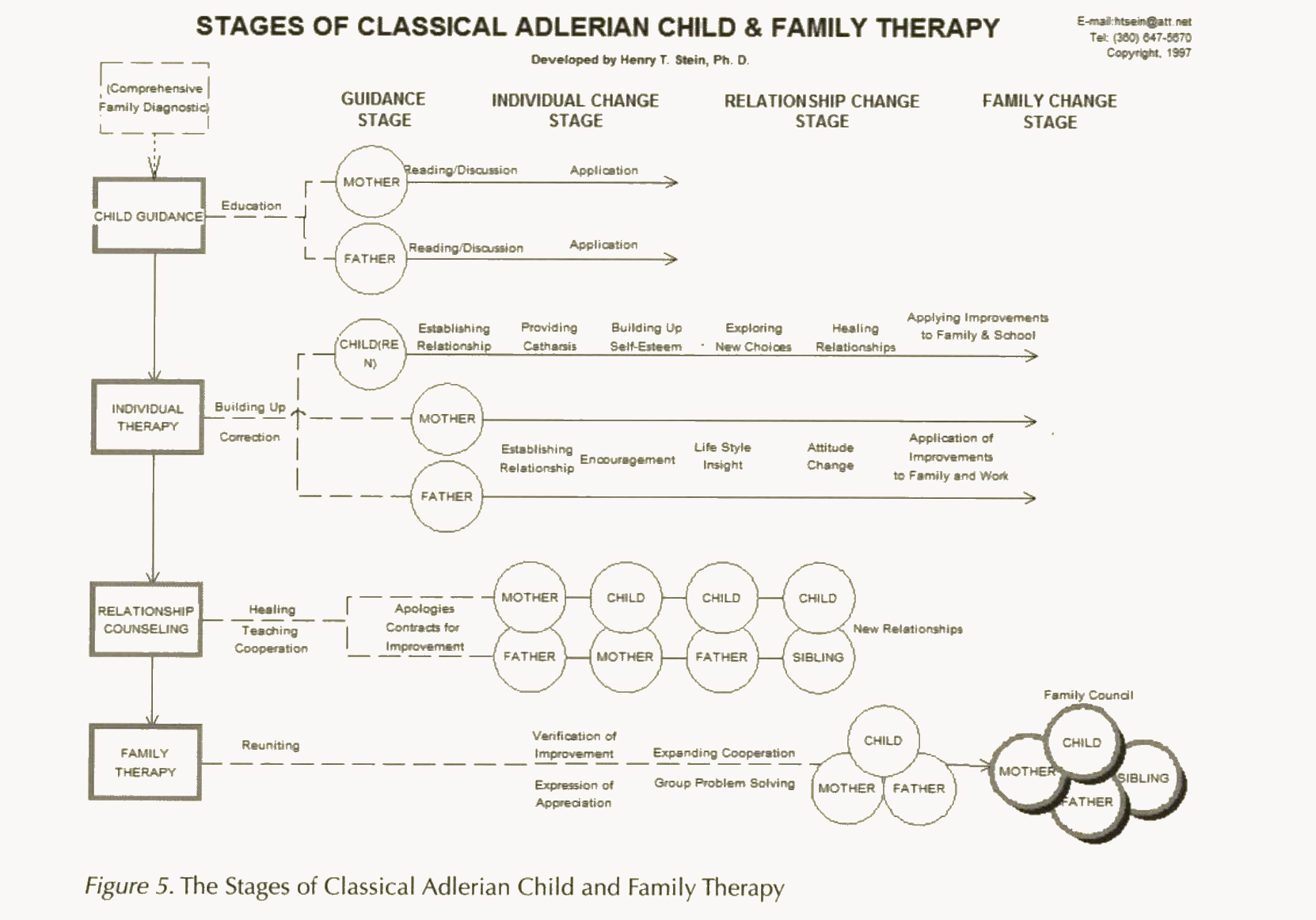
CASE EXAMPLE: TREATMENT PLAN
In the case analysis, we made our preliminary guesses about dynamics. This helped us develop a flexible, preliminary treatment plan, which was our initial "compass reading" for determining the direction we wanted to take.
Objectives. Our initial treatment plans include what movements we are trying to correct in each of the family members. The preliminary plan is not a stage of therapy but is ready to be implemented in a caring way at each stage of treatment (see Stein, 2013). The plan included the following objectives: Mason changing from superficial optimism to genuine optimism, and Emma shifting from refusing others to accepting others and valuing their attempts to connect with her. Together, Emma and Mason's objectives also included developing warmth and affection, as well as showing acceptance and encouragement toward each other and their children. The work with the parents would affect the children directly. Developing Amelia's cooperative skills in a calm, consistent, caring relationship will prepare her to be able to let go of her demanding behavior and be receptive to other adults. Developing Jacob's activity level was targeted for future intervention, when and if he would be willing to come into therapy.
Strategies. Our treatment strategy included a division of labor in which Erik focused on the couple, starting with weekly individual work with Emma and Mason. Erik met with Emma and Mason as a couple at 6 months into therapy, at their request, to determine whether some solving of problems together was necessary. The couple had shown some improvement but was not yet ready to repair, and this modality was suspended until the 13th month, when biweekly couple sessions were cooperatively instituted. It was also around this time, 16 months into therapy, that Emma's initial explorations of optimal growth led her intensive career exploration with Erik.
Jane worked with the children. She worked with Amelia on a weekly basis, slowly building their relationship, creating trust, and modeling cooperation through play. Jacob was reluctant to become involved in one-on-one sessions. As our work with the family proceeded, however, he became more comfortable with the idea of therapeutic involvement. When we introduced the idea of a weekly middle school group with our other preteen clients, he joined willingly and participated actively. Jane also offered Emma and Mason parent education on an individual basis, alternating weeks between them.
In drawing the family diagnostic process to a close, we include Figure 5, which indicates the stages of Classical Adlerian child and family therapy and its interface with the family diagnostic process. The figure is an indicator of where the healing begins, but also of where the mystery and the adventure continue.
-----------------------------------------------------------------------
REFERENCES
Bruck, A., Adler, A., & Grubbe, T. (2009). The work of an Adlerian psychologist in the schools and selected articles. In H. T. Stein & L. J. Stein (Eds.), Educating children for cooperation & contribution (Vol. 2, pp. 87-115). Bellingham, WA: The Alfred Adler Institute of Northwestern Washington.
Buhler, C. (1951). The World Test, a projective technique. Journal of Child Psychiatry, 2, 4-23.
Conners, C. K. (1997). Conners' Rating Scale/Revised-S. North Tonawanda, NY: Multi-Health Systems.
Pienkowski, D. (2014). Classical Adlerian assessment of an adult child of an alcoholic: "Queen of the derelicts." Journal of Individual Psychology, 70(4): 379-389.
Pollock, D. C., & Van Reken, R. E. (2010). Third culture kids: Growing up among worlds (2nd ed.). Boston, MA: Brealey.
Stein, H. T. (2013). Classical Adlerian Depth Psychotherapy Volume 1. Theory & practice: A Socratic approach to democratic living. Bellingham, WA: The Alfred Adler Institute of Northwestern Washington.
Stein, H. T. (2014). Classical Adlerian Depth Psychotherapy Volume 2. Creative case analysis: Uncovering the fictional final goal & the counter-fiction that hides it. Bellingham, WA: The Alfred Adler Institute of Northwestern Washington.
VandenBos, G. R. (2001). Disguising case material for publication. Unpublished manuscript, Publications Office, American Psychological Association, Washington, DC.
Wechsler, D. (2003). Wechsler Intelligence Scale for Children--Fourth edition. Lebanon, IN: Pearson Clinical Assessments.
Wechsler, D. (2009). Wechsler Individual Achievement Test--Third edition. Lebanon, IN: Pearson Clinical Assessments.
-----------------------------------------------------------------------
AUTHOR BIOS
Jane Pfefferle, MA (janepfefferle@bluewin.ch), is co-director of Family Counselling Services in Geneva, Switzerland. She obtained her Bachelor degree in Arts from Melbourne University, Australia before studying voice and music theory at the Conservatoire of Lausanne, Switzerland and going on to complete a graduate diploma in music and voice with the Societe Suisse de Pedagogie Musicale. Her interest in music and singing led her to work with people who suffered from vocal difficulties. Upon studying with Rosette Poletti she earned a diploma as a 'praticienne en relation d'aide' [practitioner of helping relations] and then completed her masters in mental health counselling at Webster University/Geneva. Jane's interest in Adlerian Psychology began by attending ICASSI where she took courses from Betty Lou Bettner. This encouraged her certification in parent education (Systematic Training for Effective Parenting, Swiss-French Association, and Positive Discipline for Parents and Teachers). Jane completed the certificate in Classical Adlerian Depth Psychotherapy in 2012.
Erik Mansager, PhD (emansager@bluewin.ch), a Licensed Clinical Professional Counselor in Illinois, is also a faculty member at Webster University/Geneva and co-director of Family Counselling Services in Geneva, Switzerland. He received his initial Adlerian training from Oscar C. Christensen and Betty J. Newlon at the University of Arizona, and completed the Certificate of Professional Studies in Individual Psychology, taught by Robert L. Powers and Jane Griffith before transitioning to Classical Adlerian Depth Psychotherapy and beginning his studies with Henry Stein in 2007. Erik has served as faculty member at ICASSI and the Adler School of Professional Psychology. He is a Diplomate in Adlerian Psychology and served on the NASAP Board of Directors for many years, concluding his service as past-president from 2006-2008. He completed his CADP certificate in 2012 and is currently preparing for certification as a training analyst.